Table of Contents
- Understanding Rounded Shoulders and Postural Imbalance
- Yoga Poses for Rounded Shoulders Correction
- Best Yoga Props for Shoulder Opening
- Stretches for Tight Chest Muscles
- How Long to Fix Rounded Shoulders with Yoga
- Building a Daily Routine for Long-Term Posture Improvement
- Integrating Ergonomic Workspace Adjustments
- Tracking Progress and Adjusting Your Practice
Last Updated: August 29, 2026
Understanding Rounded Shoulders and Postural Imbalance
Rounded shoulders develop when chest muscles tighten and upper back muscles weaken, pulling shoulder blades forward. This postural imbalance affects breathing, neck alignment, and spinal health. The underlying issue involves muscle imbalance between your anterior chain (chest, front shoulders) and posterior chain (upper back, rear shoulders). When pectorals tighten and rhomboids weaken, your scapulae can’t retract properly. The good news: muscle imbalance responds well to targeted work. Yoga poses for rounded shoulders correction address both sides, opening tight chest muscles while strengthening the posterior deltoids and upper back.
Yoga Poses for Rounded Shoulders Correction
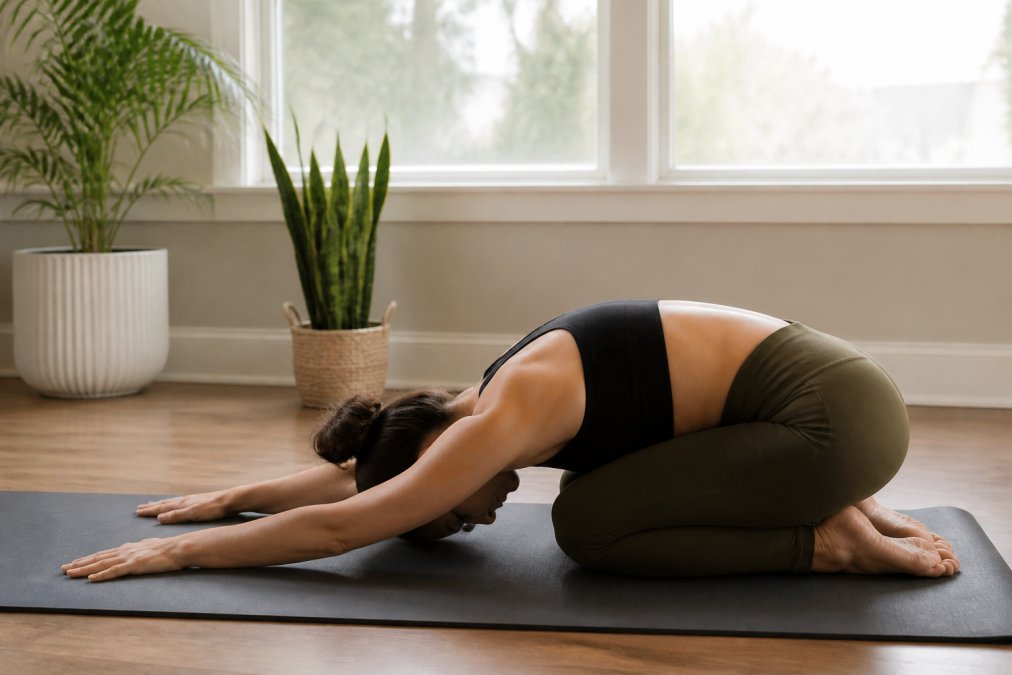
Correcting rounded shoulders requires poses that address kyphosis and restore scapular retraction. The best approaches combine chest opening with posterior chain activation. Most people see noticeable improvements within 3-4 weeks of consistent practice, though deeper postural shifts take 8-12 weeks (peer-reviewed research).
Supported Fish Pose for Chest Opening
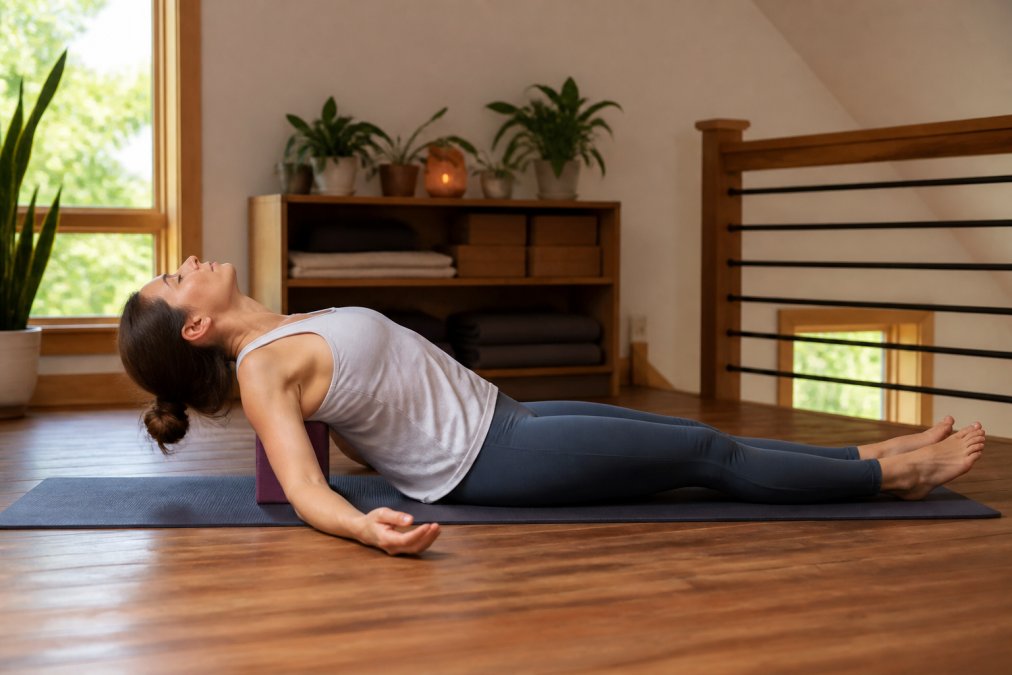
Supported fish pose is one of the most direct chest openers available. It passively stretches the pectorals while gently extending the thoracic spine, counteracting forward-rounded positioning.
To perform: Place a yoga block on its lowest height setting perpendicular to your spine, positioned just below your shoulder blades. Lie back over the block with your head supported (use another block or folded blanket under your head if needed). Let your arms relax at your sides or extend them out with palms up. Stay for 60-90 seconds, breathing deeply. The block’s support allows your chest to open fully without straining your neck.
Wall Angels for Scapular Awareness
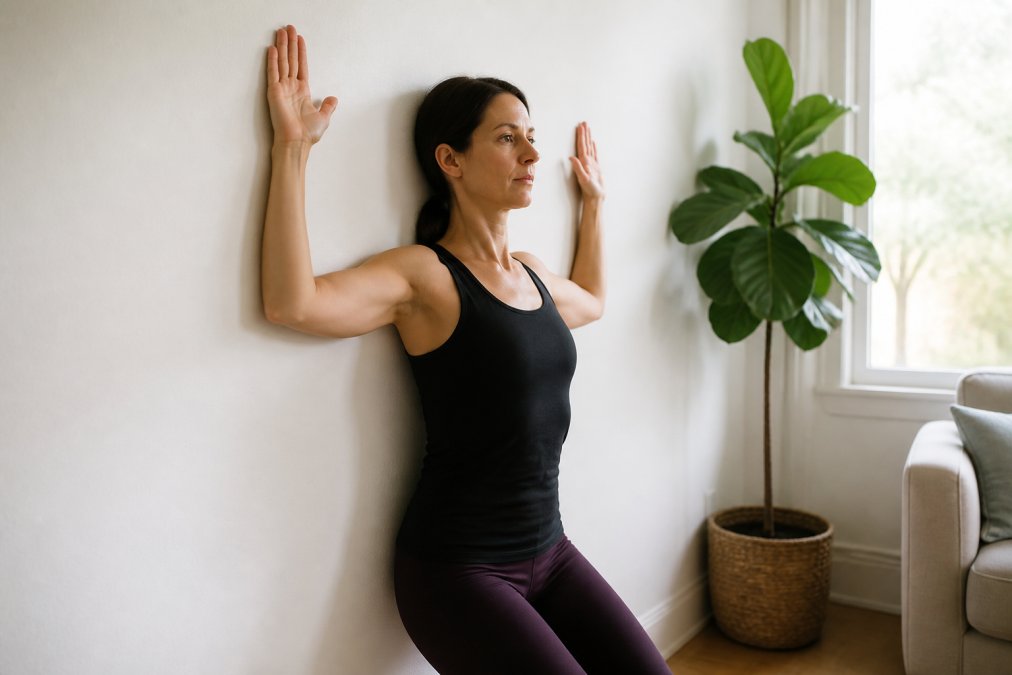
Wall angels train your scapulae to move correctly by using the wall as feedback. This exercise builds awareness of proper shoulder blade positioning while strengthening the muscles that hold them in place.
Stand with your back against a wall, feet about 6 inches away. Press your lower back gently against the wall. Raise your arms to shoulder height with elbows bent at 90 degrees, forming a "goal post" position. Slowly slide your arms upward along the wall toward your head, keeping your elbows and back of hands in contact with the wall. If you can’t maintain contact without your lower back arching or shoulders shrugging, only go as high as you can while staying connected. Slide back down slowly. Perform 10-15 repetitions.
The wall provides immediate feedback when your shoulder blades aren’t retracting properly. As your posterior deltoids and rhomboids strengthen, your range expands.
Humble Warrior for Shoulder Mobility
Humble warrior combines shoulder mobility work with a mild backbend, opening the chest while engaging the posterior chain.
From warrior I position (front knee bent, back foot grounded at 45 degrees), clasp your hands behind your back. Gently draw your hands toward the ground while lifting your chest. You should feel a stretch across your chest and anterior shoulders. Keep your shoulders drawn back and down. Hold for 30-45 seconds per side.
Humble warrior works because it combines active shoulder retraction with passive chest opening, simultaneously strengthening muscles that hold your shoulders back while lengthening muscles that pull them forward.
Reverse Prayer Pose for Posterior Chain Activation
Reverse prayer pose directly activates your rhomboids and posterior deltoids while opening your chest.
Stand tall with your arms at your sides. Bring your hands together behind your back with palms pressed together at heart level. Gently press your palms together while drawing your elbows toward your ribs. You should feel activation across your upper back and a stretch through your chest. Hold for 30-60 seconds.
The pressing action creates isometric contraction in your posterior chain, building strength exactly where rounded shoulders need it most.
Cat-Cow Flow for Thoracic Spine Mobility
Cat-cow flow mobilizes your entire spine while teaching proper scapular movement.
Start on hands and knees with wrists under shoulders and knees under hips. For cow pose: drop your belly, lift your gaze, and draw your shoulder blades back and down. For cat pose: round your spine, tuck your chin, and protract your shoulder blades. Flow between these positions for 8-10 cycles, moving with your breath.
Cat-cow addresses multiple aspects of rounded shoulder correction simultaneously, strengthening your posterior chain while mobilizing your thoracic spine.
Best Yoga Props for Shoulder Opening
Props transform yoga poses into more effective corrective tools by providing support, feedback, and the ability to deepen stretches safely. Yoga blocks are the most valuable prop for rounded shoulder correction. A strap extends your reach in poses where your arms don’t naturally connect. Blankets provide cushioning and support for your head and neck. A wall is free and provides immediate feedback about alignment.
Using props isn’t a shortcut, it’s a training tool that allows you to experience proper alignment while building the strength to eventually move deeper into poses.
Stretches for Tight Chest Muscles
Tight pectorals are usually the primary driver of rounded shoulders. The most effective chest stretches combine passive lengthening with active engagement of opposing muscles.
Doorway chest stretch: Stand in a doorway with one arm raised to 90 degrees, forearm on the doorframe. Step forward until you feel a stretch across your chest. Hold for 45-60 seconds per side.
Cross-body shoulder stretch: Bring one arm across your body and gently pull it closer with your opposite hand. Hold for 30-45 seconds per side.
Thread the needle: From hands and knees, thread one arm under your body while rotating your torso. Hold for 30-45 seconds per side.
These stretches work best when combined with strengthening work. Stretching alone provides temporary relief but doesn’t address underlying weakness.
How Long to Fix Rounded Shoulders with Yoga
Timeline for correcting rounded shoulders depends on severity, consistency, and how long the postural pattern has existed. Most people see noticeable changes within 2-3 weeks of daily practice. More significant postural shifts typically take 8-12 weeks. Deeply ingrained patterns may require 3-6 months.
The key variable is consistency. Practicing 20 minutes daily produces faster results than 60 minutes once weekly (peer-reviewed research). Your nervous system needs regular input to reprogram postural patterns.
Noticeable postural changes typically appear within 3-4 weeks of daily practice. Deeper, lasting corrections usually require 8-12 weeks of consistent work. Daily 20-minute sessions outperform occasional longer sessions.
Building a Daily Routine for Long-Term Posture Improvement
A sustainable daily routine is where real postural change happens. A basic routine takes 15-20 minutes and addresses all corrective elements: 2 minutes of cat-cow flow, 90 seconds of supported fish pose, 15 wall angels per side, 60 seconds of reverse prayer pose, and doorway chest stretches plus thread the needle (45 seconds per side each).
Timing matters. Many people practice in the morning to set good posture for the day, or in the evening to counteract desk hours. The best time is whenever you’ll actually do it consistently.
Progressive overload keeps your nervous system engaged. After 3-4 weeks, increase supported fish pose to 2 minutes. After 6 weeks, add more challenging poses. This progression prevents adaptation plateaus.
Practice at the same time daily to build habit strength. Morning routines set good posture for the day; evening routines counteract desk hours. Commit to the same time for at least 30 days.
Integrating Ergonomic Workspace Adjustments
Yoga poses work best when combined with ergonomic changes. If you’re spending 8 hours daily in a position that creates rounded shoulders, yoga can’t overcome that alone.
Monitor height: Your screen should be at eye level when sitting with good posture (osha.gov). Adjust using a stand or books until the top of the screen aligns with your eyes.
Chair height: Your feet should rest flat on the floor with knees at 90 degrees. Your desk should be at elbow height when your shoulders are relaxed.
Keyboard and mouse placement: These should be close enough that your elbows stay near your ribs. Reaching forward forces shoulder protraction and forward head posture.
Movement breaks: Stand and move every 30-60 minutes. During breaks, perform wall angels or reverse prayer pose to reinforce corrective patterns.
The combination of ergonomic improvements and yoga practice creates lasting change.
Tracking Progress and Adjusting Your Practice
Measuring progress keeps you motivated and helps identify what’s working.
Photography: Take a side-view photo of your posture weekly from the same distance and angle. Over weeks and months, these photos show postural changes that feel subtle day-to-day.
Mirror work: Practice poses in front of a mirror to see whether your shoulders are actually retracting or whether you’re compensating with other muscles.
Range of motion: Track how far you can move in wall angels while maintaining wall contact, or how deeply you can fold in humble warrior.
Pain and tension levels: Many people notice decreased neck tension, fewer headaches, and reduced upper back pain as posture improves.
If you’re not seeing progress after 4-6 weeks of consistent practice, something needs changing. Working with a qualified instructor helps identify what needs adjustment.
Avoid practicing only your favorite poses. You need both opening work (chest stretches) and strengthening work (wall angels, reverse prayer). A balanced routine addressing all components produces faster, more lasting results.
Rounded shoulders don’t have to be permanent. The postural imbalance responds well to targeted yoga practice combined with ergonomic improvements. At Holistic & Wellness Medicine, the integrated approach focuses on root cause healing. The yoga poses outlined here address root causes, tight pectorals, weak posterior chain, and poor scapular control, rather than just masking symptoms.
Start your wellness journey today by committing to a daily routine. Even 15 minutes of consistent practice creates noticeable changes within weeks. Combined with ergonomic workspace adjustments, yoga becomes a powerful tool for lasting postural correction and long-term wellbeing.
Frequently Asked Questions
Can yoga correct rounded shoulders?
Yes, yoga poses for rounded shoulders correction can help restore posture when practiced consistently. Poses that target scapular retraction, chest opening, and thoracic spine mobility address the muscle imbalances underlying forward head posture. Results depend on how long you've had rounded shoulders, your daily habits, and consistency with practice. Combining yoga with ergonomic workspace changes and professional guidance yields better outcomes than yoga alone.
How long does it take to fix rounded shoulders with yoga?
Most people notice improved alignment and reduced tension within 4 to 6 weeks of consistent daily practice. Significant postural changes typically take 3 to 6 months, depending on the severity of kyphosis and how much time you spend in positions that reinforce rounded shoulders. Patience is essential, rounded shoulders develop over months or years, so reversing them requires sustained effort. Progress tracking through photos or posture assessments helps maintain motivation.
What are the best yoga props for shoulder opening?
Yoga blocks, straps, and bolsters are the most effective props for shoulder opening. Blocks support the chest in poses like supported fish, allowing deeper pectoral stretch without strain. Straps help you maintain proper alignment in poses like humble warrior and reverse prayer, preventing compensation patterns. A bolster or rolled blanket under the thoracic spine provides gentle chest expansion. Props make corrective poses more accessible and reduce injury risk, especially if you have shoulder impingement or tight chest muscles.
Which stretches work best for tight chest muscles?
Supported fish pose, reverse prayer pose, and doorway chest stretches target pectoral tightness most effectively. Supported fish opens the anterior shoulder and chest while protecting the lower back. Reverse prayer pose combines chest opening with posterior deltoid and rhomboid activation. Doorway stretches isolate pectoral muscles when done correctly. Hold each stretch for 30 to 60 seconds, breathe deeply, and avoid bouncing. Combining these stretches with strengthening poses like wall angels prevents muscle imbalance from returning.
Sources:
American Physical Therapy Association guidelines on postural correction
National Institutes of Health research on postural ergonomics and workplace setup
Journal of Bodywork and Movement Therapies studies on yoga for posture improvement
This article was written using GrandRanker


5 Natural Remedies for Anxiety and Stress at Home
Discover 5 natural remedies for anxiety and stress at home, from breathing exercises to herbal supplements. Learn how functional medicine can help. Start.

How to Improve Posture to Reduce Pain: A 2026 Guide
Learn how to improve posture to reduce pain with exercises, stretches, and ergonomic tips. Discover a holistic approach to lasting relief. Start today.

How to Treat Adrenal Fatigue Without Medication
Learn how to treat adrenal fatigue without medication using diet, stress management, and natural supplements. Discover practical steps to restore.