

Table of Contents
- Why Sleep Posture Matters for Your Spine
- Best Sleeping Position for Back Pain
- How to Use Pillows for Spinal Alignment
- Stretches to Improve Posture Before Bed
- Arm and Shoulder Positioning for Sleep
- Sleep Hygiene and Postural Correction
- Post-Injury Sleep Posture Protocols
- Creating Your Personal Sleep Posture Plan
Last Updated: August 24, 2026
Why Sleep Posture Matters for Your Spine
How you sleep directly affects your spinal alignment. Eight hours of misalignment each night creates cumulative stress comparable to poor daytime posture throughout the day. Your spine maintains natural curves, cervical inward, thoracic outward, lumbar inward, and sleep that disrupts this neutral position forces vertebrae into unnatural angles, straining ligaments and muscles that should be relaxed during recovery.
At Holistic & Wellness Medicine, we see patients whose chronic pain may be influenced by sleep positioning. When your spine is misaligned at night, your muscles may work to stabilize it even while you sleep, potentially causing you to wake tense and stiff. Over months and years, this pattern can contribute to postural challenges that daytime stretching cannot fully resolve. The good news: improving sleep posture requires no special equipment, just knowledge and intentional positioning.
Your sleep posture directly influences your daytime pain levels and long-term spinal health. Eight hours of poor alignment each night compounds structural stress that daytime activity cannot fully reverse.
Best Sleeping Position for Back Pain
Back sleeping with proper support
Back sleeping is the gold standard for spinal alignment when done correctly. Your spine naturally maintains its neutral curve when you lie flat on your back with proper support under your head and lumbar region. This position distributes body weight evenly across the mattress and eliminates rotational stress.
Your pillow should support your cervical spine at the same height as your shoulders. If your pillow is too high, your chin tucks toward your chest, creating forward head posture even while lying down. If too low, your head tilts backward, hyperextending your cervical spine.
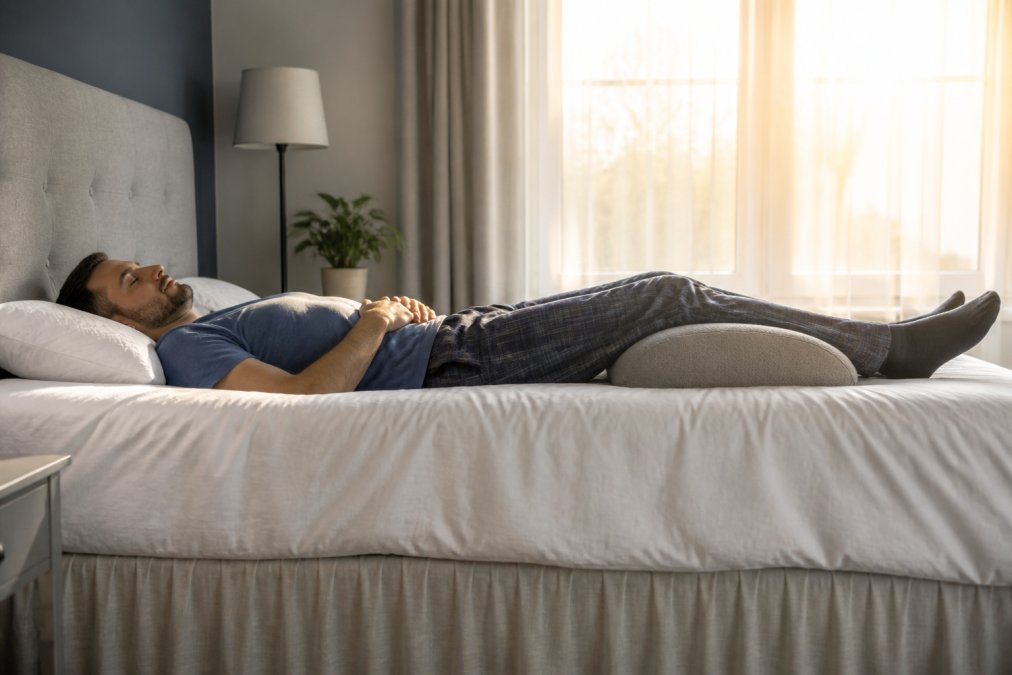
Lumbar support is equally critical. Placing a bolster, rolled towel, or pillow under your knees shifts your pelvic angle and naturally restores lumbar curve. Your lower back should have a small space, roughly the thickness of your hand, between it and the mattress.
If back sleeping feels uncomfortable initially, start with a bolster under your knees and gradually reduce it as your body adapts. Many people find the adjustment takes two to three weeks.
Side sleeping for spinal alignment
Side sleeping is the second-best option when proper positioning is maintained. Your spine should remain in a straight line from your head through your pelvis. Your pillow height is critical, your head should rest at the same height as your shoulders, preventing your cervical spine from bending downward or tilting upward.
Between your knees, place a pillow or bolster to prevent your top leg from dropping across your body. When your top leg falls, it rotates your pelvis and creates a lateral curve in your lumbar spine. Rotating sides throughout the night distributes pressure load evenly.
Avoid curling into a fetal position while side sleeping. The forward spinal flexion combined with hip and knee bending creates excessive pressure on intervertebral discs and strains your cervical spine.
Why stomach sleeping creates strain
Stomach sleeping is the position most chiropractors and physical therapists discourage. When you lie on your stomach, your spine must rotate to one side so you can breathe, you cannot sleep face-down in a neutral position. This rotation creates asymmetrical stress on your cervical spine and forces your lumbar spine into extension.
Your neck rotation in stomach sleeping is extreme. To breathe, you turn your head 90 degrees, hyperrotating your cervical vertebrae and straining facet joints. Your lumbar spine also suffers as your pelvis sinks into the mattress while your chest is supported, creating an arch in your lower back. If you have existing lower back pain, stomach sleeping almost always makes it worse.
If you’re a stomach sleeper, transition gradually by sleeping on your side for part of the night, then gradually increasing the time.
How to Use Pillows for Spinal Alignment
Pillow height and neck strain correlation
The relationship between pillow height and cervical spine strain is one of the most underestimated factors in sleep posture. A pillow that’s too high forces your chin toward your chest, creating cervical flexion and mimicking forward head posture from desk work. A pillow that’s too low allows your head to tilt backward, hyperextending your cervical spine and compressing posterior facet joints.
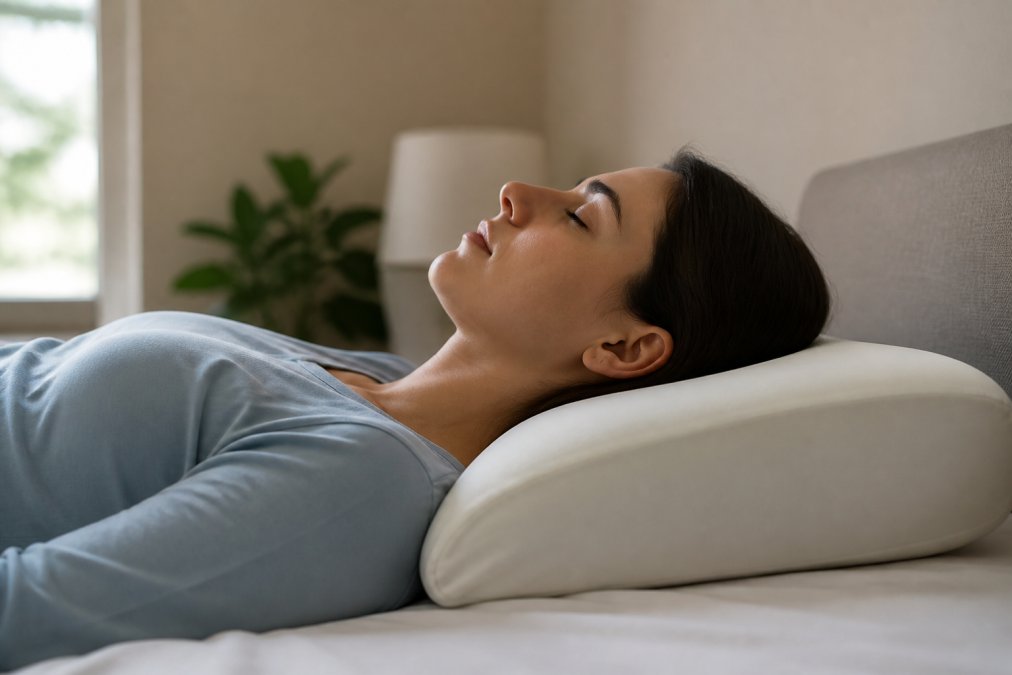
The correct pillow height depends on your shoulder width and mattress firmness. A general guideline is that your pillow should be four to six inches thick when compressed under your head’s weight (the American Academy of Dermatology). Your head and neck should form a neutral line with your spine, not flexed or extended. Memory foam pillows offer an advantage because they conform to your head and neck shape, distributing pressure more evenly than traditional pillows.
Supporting your cervical spine
Your cervical spine needs support not just from your pillow but from the angle at which you position your head. Your head should rest in a neutral position, ears aligned with your shoulders, chin parallel to the floor.
For back sleepers, your pillow should fill the space between your head and the mattress without tilting your head in any direction. For side sleepers, your pillow must support the gap between your shoulder and your neck. If this gap isn’t filled, your cervical spine bends laterally toward the mattress.
Avoid pillows that are too soft or too firm. The ideal pillow provides support while allowing some conforming to your head’s shape.
Lumbar support and mattress firmness
Your lumbar spine maintains its natural inward curve when properly supported. Back sleepers need lumbar support because the natural curve of the lumbar spine creates a gap between your lower back and the mattress. Placing a pillow or bolster under your knees shifts your pelvic angle and restores the lumbar curve.
Your mattress firmness plays a larger role than most people realize. The ideal firmness is medium to medium-firm, firm enough to support your spine’s natural curves but soft enough to conform to your body’s shape without creating pressure. If your current mattress is too soft, adding a firmer layer underneath can help. If it’s too firm, a mattress topper can provide additional conforming while maintaining support.
Test your mattress firmness by lying on your back and checking if your lower back has a small gap between it and the mattress. If your lower back is pressed flat or if there’s excessive space, your mattress firmness needs adjustment.
Stretches to Improve Posture Before Bed
Gentle spinal mobility moves
Performing gentle stretches before bed prepares your spine for proper positioning during sleep. These movements increase mobility in your thoracic and lumbar spine, reduce muscle tension, and signal to your nervous system that sleep is approaching. Perform these stretches slowly and hold each position for 20 to 30 seconds without bouncing.
The cat-cow stretch mobilizes your entire spine. Start on your hands and knees with your wrists under your shoulders and your knees under your hips. Inhale and drop your belly toward the floor, lifting your gaze upward (cow position), creating extension in your spine. Exhale and round your spine, tucking your chin toward your chest (cat position), creating flexion. Move between these positions slowly for 8 to 10 repetitions.
The seated spinal twist addresses rotational tension. Sit on the floor with your legs extended, then bend your right knee and place your right foot outside your left knee. Inhale to lengthen your spine, then exhale and twist your torso to the right, placing your left elbow outside your right knee. Hold for 20 to 30 seconds, then repeat on the other side.
Start your wellness journey today! →
Hip and shoulder alignment exercises
Your hips and shoulders influence your spinal alignment during sleep. Tight hip flexors from sitting all day can tilt your pelvis forward, creating excessive lumbar curve. Tight chest muscles from desk work can round your shoulders, affecting your thoracic spine.
The 90-90 hip stretch opens your hip flexors and external rotators. Lie on your back with your right leg extended and your left knee bent at 90 degrees, with your left foot placed on the floor outside your right knee. Gently press your left knee toward the floor. Hold for 30 to 60 seconds, then repeat on the other side.
The doorway chest stretch addresses tight pectoral muscles. Stand in a doorway with your right arm raised to 90 degrees, your forearm against the doorframe. Step forward slightly, allowing the doorframe to gently stretch your right chest. Hold for 30 to 60 seconds, then repeat on the other side.
Performing these stretches 15 to 20 minutes before bed improves spinal mobility and reduces muscle tension, making it easier to maintain proper sleep posture throughout the night.
Arm and Shoulder Positioning for Sleep
Your arm and shoulder positioning during sleep directly affects your cervical and thoracic spine alignment. Back sleepers should position their arms at their sides or with elbows bent at roughly 90 degrees, hands resting on their abdomen or torso. Avoid sleeping with your arms overhead, which hyperextends your shoulders and creates tension in your chest and anterior shoulder muscles.
Side sleepers should position their bottom arm either extended in front of them or bent at the elbow with their hand near their pillow. Avoid positioning your bottom arm under your body, which compresses your shoulder. When your arms are positioned in tension, your nervous system remains partially activated even during sleep. Positioning your arms in relaxed, neutral positions signals your nervous system that it’s safe to fully relax, improving sleep quality and reducing morning stiffness.
Sleep Hygiene and Postural Correction
Your bedroom temperature should be cool, between 65 and 68 degrees Fahrenheit (peer-reviewed research). A cool environment promotes deeper sleep, during which your muscles are more relaxed and your body is more likely to maintain proper positioning. Your bedroom should be dark enough that you cannot see your hand in front of your face. Light exposure suppresses melatonin production and reduces sleep quality.
Your pre-sleep routine influences how quickly you fall asleep and how deeply you sleep. Avoid screens for 30 to 60 minutes before bed; blue light suppresses melatonin and keeps your nervous system activated. Instead, perform the stretches described earlier, read, or practice gentle breathing exercises.
Caffeine and alcohol both disrupt sleep quality and increase nighttime position changes. Caffeine consumed after 2 PM can remain in your system for 8 to 10 hours, preventing deep sleep (peer-reviewed research). Alcohol may help you fall asleep initially but fragments your sleep cycles, causing frequent waking and position changes.
If you wake with pain or stiffness despite improving your sleep posture, your mattress or pillow may need adjustment, or an underlying structural issue may need professional evaluation. Poor sleep posture is a common cause of morning pain, but it’s not the only cause.
Post-Injury Sleep Posture Protocols
If you’re recovering from a back injury, neck injury, or surgical procedure, your sleep posture becomes even more critical. Proper positioning during sleep supports healing and prevents re-injury during your recovery period.
For acute lower back injuries, back sleeping with significant lumbar support is typically recommended. Place one pillow under your knees and potentially a second pillow under your lower back to maintain exaggerated lumbar support during the acute phase. As healing progresses and pain decreases, gradually reduce the lumbar support until you reach standard positioning.
For acute cervical spine injuries, positioning depends on the specific injury. In many cases, back sleeping with a cervical pillow that provides moderate support is recommended. Follow your healthcare provider’s specific positioning recommendations based on your injury type and healing phase.
Creating Your Personal Sleep Posture Plan
Improving your sleep posture is a gradual process that requires awareness and intentional practice. Start by identifying your current sleep position. Place your phone with a camera on your nightstand and record yourself sleeping for one night, or ask your sleep partner to observe your position.
Next, assess your current pillow and mattress. Your pillow should be no more than 5 to 6 years old; older pillows lose their support and conforming properties. Your mattress should be 7 to 10 years old at most. If either is older, replacement may be necessary.
Implement one change at a time. If you’re currently a stomach sleeper, don’t attempt to become a back sleeper overnight. Instead, spend one week sleeping on your side for half the night, then gradually increase the duration.
Track your morning symptoms for two weeks before making changes, then again for two weeks after each adjustment. Note your pain level, stiffness, sleep quality, and any other relevant symptoms. Give each change at least two to three weeks before evaluating its effectiveness.
Chronic pain that may be influenced by poor sleep posture is potentially preventable and reversible. The positioning changes described here require no special equipment and no financial investment, only awareness and intentional practice. If you’ve tried these adjustments and your morning pain persists, underlying structural issues may need professional evaluation. The team at Holistic & Wellness Medicine combines chiropractic assessment, functional medicine analysis, and personalized movement strategies to address the root causes of sleep-related pain and help you build long-term spinal resilience. Start your wellness journey today by evaluating your current sleep posture and implementing one targeted change this week.
Frequently Asked Questions
What are the signs of bad sleep posture?
Common signs include waking with neck or lower back pain, shoulder tension, numbness in your arms, and chronic headaches. You might also notice stiffness that takes hours to resolve after waking. Bad posture during sleep can create pressure points on your joints and vertebrae, potentially preventing proper muscle relaxation. If you wake feeling more tired than when you went to bed, poor spinal alignment may be disrupting your sleep quality and preventing deep rest.
Does pillow height affect spinal alignment?
Yes, significantly. Pillow height directly impacts your cervical spine position and neck strain. A pillow that's too high forces your neck into excessive flexion, while one too low allows your head to drop backward. The ideal pillow height keeps your cervical spine in neutral alignment, your ears, shoulders, and hips form a straight line. If you sleep on your side, you may need more loft than back sleepers. Testing different pillow heights and observing where you feel tension helps you find the right fit for your body.
How can I improve posture while sleeping if I have a previous injury?
Post-injury sleep posture requires specific positioning based on your injury location. For shoulder injuries, avoid sleeping on the affected side and use a pillow to support the arm in a neutral position. For lower back injuries, back sleeping with lumbar support or side sleeping with a bolster between the knees reduces joint stress. Consult with a qualified healthcare provider to develop a post-injury sleep posture protocol tailored to your condition, as improper positioning can delay healing and increase chronic pain risk.
What's the healthiest sleeping position for posture?
Back sleeping with proper support is generally considered the healthiest for spinal alignment, as it distributes your weight evenly across your vertebral column and maintains natural curves. Side sleeping is the second-best option when done correctly with a pillow supporting your head and a bolster between your knees. Both positions support neutral spine alignment and reduce pressure points. The worst position is stomach sleeping, which forces your cervical spine into rotation and disrupts your natural posture. Your best position depends on any existing injuries or chronic pain patterns.
This article was written using GrandRanker


5 Natural Remedies for Anxiety and Stress at Home
Discover 5 natural remedies for anxiety and stress at home, from breathing exercises to herbal supplements. Learn how functional medicine can help. Start.

How to Improve Posture to Reduce Pain: A 2026 Guide
Learn how to improve posture to reduce pain with exercises, stretches, and ergonomic tips. Discover a holistic approach to lasting relief. Start today.

How to Treat Adrenal Fatigue Without Medication
Learn how to treat adrenal fatigue without medication using diet, stress management, and natural supplements. Discover practical steps to restore.