
Table of Contents
- What Is Proper Posture and Why It Matters
- The Root Causes of Bad Posture
- Step-by-Step: How to Fix Posture Naturally
- Best Exercises for Posture Improvement
- Stretches for Back, Chest, and Shoulder Flexibility
- How Long Does It Take to Fix Posture Naturally
- Posture Exercises for Desk Workers and Remote Employees
- Benefits of Good Posture for Overall Health
Last Updated: July 29, 2026
What Is Proper Posture and Why It Matters
Proper posture is the alignment of your body against gravity in a way that minimizes stress on your muscles, joints, and ligaments while maximizing functional capacity.
Understanding Neutral Spine Alignment
Neutral spine alignment maintains your spine’s natural curves, cervical at the neck, thoracic in the mid-back, and lumbar in the lower back, in their optimal state without excessive rounding or arching. When aligned properly, your ears sit over your shoulders, shoulders over hips, and hips over ankles. This stacked position distributes force evenly throughout your body rather than concentrating stress on specific joints. True neutral spine is dynamic, not rigid, your body is designed to move, and good posture supports that movement.
How Poor Posture Develops
Poor posture emerges gradually through repeated habits: hunching at a desk, cradling your phone between ear and shoulder, or favoring one side when standing. A sedentary lifestyle accelerates this process. When you sit most of the day, your hip flexors tighten, chest muscles shorten, and upper back muscles weaken from disuse. Forward head posture is the most common problem today, for every inch your head moves forward, your neck experiences an additional 10 pounds of stress.
The Root Causes of Bad Posture
Muscle imbalances are the primary driver. When certain muscles become tight (chest, front shoulders, hip flexors) and others weaken (upper back, deep core, glutes), your skeleton shifts to accommodate these imbalances.
Ergonomic environments compound the problem. A desk that’s too high or low, a chair without lumbar support, or a monitor positioned below eye level forces your body into compromised positions for hours daily.
Sedentary behavior is particularly damaging. Your postural muscles atrophy without regular activation, making maintaining good posture exhausting rather than effortless.
Psychological factors also play a role. Stress and anxiety cause people to unconsciously round their shoulders forward and tense their neck muscles, creating a feedback loop that worsens posture.
Poor posture is a habit pattern reinforced by your nervous system, not purely a structural problem. Addressing it requires retraining your body’s sense of what feels “normal”, which takes time and consistency.
Step-by-Step: How to Fix Posture Naturally
Fixing posture naturally involves addressing muscle imbalances, building awareness, and establishing new movement patterns. This process typically takes 4-8 weeks to show noticeable results.
Step 1: Assess Your Current Alignment
Stand naturally in front of a mirror in profile view and look at the relationship between your ear, shoulder, hip, knee, and ankle. Are they stacked vertically, or is your head forward? Take a photo from the side as your baseline.

The wall test provides another useful assessment. Stand with your back against a wall, heels about six inches away. Your head, shoulders, and buttocks should touch the wall comfortably. If your head doesn’t reach the wall without effort, you have forward head posture.
Record yourself walking and standing naturally on your phone. This external perspective reveals patterns you can’t feel from the inside.
Step 2: Strengthen Your Core Muscles
Your core includes your transverse abdominis, rectus abdominis, obliques, multifidus, erector spinae, and pelvic floor muscles. When your core is weak, your spine lacks stability and your body over-relies on neck and upper back muscles.
Dead bugs teach your nervous system to activate core muscles properly: lie on your back with arms extended toward the ceiling and knees bent at 90 degrees. Slowly lower your right arm overhead while straightening your left leg, hovering just above the floor. Return and alternate sides. Perform 3 sets of 10 repetitions per side, keeping your lower back flat.
Bird dogs teach spinal stabilization while moving your limbs: start on hands and knees, then extend your right arm forward while straightening your left leg behind you. Hold for two seconds and alternate. Perform 3 sets of 10 repetitions per side.
Planks build core endurance. Start with 20-30 second holds and gradually increase duration, maintaining perfect form throughout.
Step 3: Address Muscle Imbalances
Your chest and front shoulder muscles are typically tight, while your upper back muscles are weak. Your hip flexors are tight from sitting, while your glutes are weak from underuse.
Doorway stretches release tight chest muscles. Stand in a doorway with your arm bent at 90 degrees, forearm against the frame. Step forward gently until you feel a stretch across your chest. Hold for 30 seconds and repeat 3 times per side.
Resistance band rows strengthen your upper back. Anchor a band at chest height, grab both ends, and pull toward your body, squeezing your shoulder blades together. Perform 3 sets of 12-15 repetitions.
Low lunges lengthen tight hip flexors. Step forward into a lunge, drop your back knee to the ground, and gently press your hips forward. Hold for 30 seconds and repeat 3 times per side.
Glute bridges strengthen your gluteal muscles. Lie on your back with knees bent and feet flat, then push through your heels to lift your hips toward the ceiling. Squeeze your glutes at the top and hold for one second. Perform 3 sets of 15 repetitions.
Step 4: Incorporate Daily Movement Habits
Exercises are important, but the remaining 23+ hours of your day matter more for postural habits. Incorporate frequent position changes throughout your day, if you sit for work, stand for 10 minutes every hour.
Walking is one of the most underrated postural interventions. A 10-minute walk several times daily activates your core, engages your glutes, and reinforces proper spinal alignment.
Practice conscious posture checks throughout your day. Set a phone reminder every hour to assess your alignment. Yoga and tai chi are particularly effective for postural correction because they combine strength, flexibility, and mindfulness, rewiring your nervous system’s baseline posture.
Best Exercises for Posture Improvement
Certain exercises are particularly effective for correcting common postural problems. Perform these 4-5 times weekly for at least 4 weeks before expecting significant changes.
Scapular Retraction and Upper Back Strengthening
Forward shoulders are the most visible postural problem. Scapular retraction exercises reverse this by teaching your back muscles to pull your shoulder blades down and back.
Prone Y-T-W raises target muscles between your shoulder blades. Lie face down on a bench with your arms hanging toward the floor. Raise your arms into a Y position (overhead at 45 degrees), then lower. Next, raise into a T position (directly out to the sides), then lower. Finally, raise into a W position (elbows bent, upper arms perpendicular to your body). Perform 10 repetitions of each position for 3 sets.
Face pulls using a resistance band target rear deltoids and upper back muscles. Anchor the band at eye level, grab both ends, and pull toward your face, spreading the band apart as you pull.
Upper back strength is the foundation of good posture. Without strong upper back muscles, your shoulders will perpetually drift forward.
Pelvic Tilt and Lumbar Support Exercises
Your pelvis is the foundation of your spine. When it tilts excessively forward, your lower back arches excessively and your core disengages.
Pelvic tilt exercises teach your nervous system to find neutral pelvic position. Lie on your back with knees bent and feet flat. Tilt your pelvis to create an anterior tilt (lower back arches), then tilt the opposite direction to flatten your lower back. Find the midpoint where your lower back has a slight natural curve. Hold for five seconds and repeat 15-20 times.
Superman holds strengthen your erector spinae muscles. Lie face down and simultaneously raise your arms and legs slightly off the ground. Hold for 5-10 seconds and repeat 10-15 times for 3 sets.
Stretches for Back, Chest, and Shoulder Flexibility
Flexibility work is essential because tight muscles prevent proper posture.
Releasing Tight Chest and Anterior Shoulders
Doorway stretches are the most accessible chest stretch. Stand in a doorway with your arm bent at 90 degrees, forearm against the frame. Step forward gently until you feel a stretch across your chest. Hold for 30-45 seconds and repeat 3 times per side, twice daily.
Stability ball stretches provide deeper chest stretching. Lie on your back on a stability ball positioned under your mid-back. Let your arms hang toward the floor and relax into the stretch. Hold for 60 seconds and repeat 2-3 times.
Sleeper stretches target posterior shoulder muscles. Lie on your right side with your right arm bent at 90 degrees in front of you. Use your left hand to gently press your right forearm toward the floor. Hold for 30 seconds and repeat 3 times per side.
Thoracic Spine Mobility Work
Your thoracic spine is designed to rotate and extend. When it becomes stiff, your cervical and lumbar spine compensate by moving excessively.
Thoracic extensions over a foam roller improve mid-back mobility. Place a foam roller perpendicular to your spine at mid-back level. Support your head with your hands and gently extend backward over the roller. Hold for 10 seconds and repeat 10-15 times.
Quadruped thoracic rotations improve rotational mobility. Start on hands and knees, place one hand behind your head, and rotate your upper body, bringing your elbow toward your opposite knee, then opening your chest toward the ceiling. Perform 10-12 rotations per side for 2-3 sets.
How Long Does It Take to Fix Posture Naturally
The timeline for postural correction depends on the severity of your imbalances, your consistency with exercises, and your daily movement habits. Most people notice improvements within 2-3 weeks, but significant changes typically require 8-12 weeks.
Building Sustainable Posture Habits
The difference between temporary improvement and lasting change is habit formation. Your brain encodes habits through repetition and reward. Start with one small habit: a daily 10-minute walk, a 5-minute stretching routine, or hourly posture checks. Once this becomes automatic (typically 3-4 weeks), add another habit.
Accountability accelerates habit formation. Share your goals with a friend, join a yoga class, or work with a practitioner who can monitor your progress.
Track your progress objectively. Take posture photos every two weeks. Notice whether daily activities feel easier, can you sit at your desk longer without neck pain? These functional improvements provide motivation to continue.
Posture Exercises for Desk Workers and Remote Employees
Desk workers face unique postural challenges from eight hours of sitting daily plus forward head posture from monitor use.
Ergonomic Setup and Desk Organization
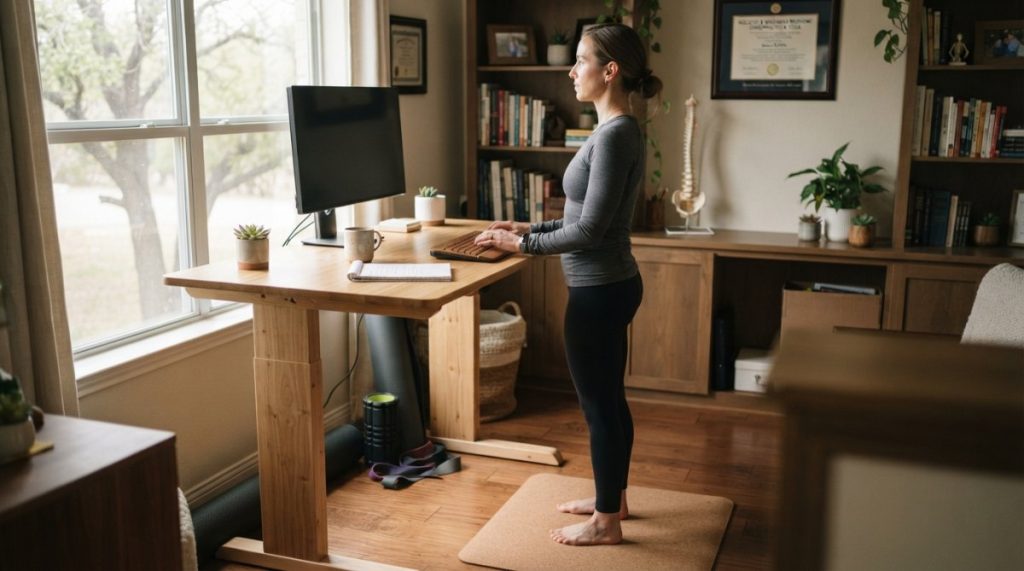
Your monitor should be at eye level when sitting upright. Use a monitor stand or laptop riser to achieve proper height.
Your keyboard and mouse should be at elbow height when your arms hang naturally at your sides. Your chair should support your lower back’s natural curve. Your feet should rest flat on the floor or a footrest.
According to research from the National Institute for Occupational Safety and Health, proper ergonomic setup reduces musculoskeletal pain by up to 54% in desk workers.
Micro-Movement Breaks Throughout Your Day
Implement the "20-8-20 rule": every 20 minutes, take an 8-second break to move. Every hour, take a 2-3 minute movement break. Stand for at least 30 minutes during your workday, alternating between sitting and standing every 30 minutes.
Perform posture-specific exercises during breaks: wall angels, scapular squeezes, or neck retractions. Research from the American College of Sports Medicine indicates that frequent movement breaks are more effective for preventing postural problems than occasional intense exercise sessions.
Benefits of Good Posture for Overall Health
Good posture has measurable effects on your physical and mental health. Proper spinal alignment reduces stress on your joints and muscles, decreasing chronic pain. Your organs function more efficiently when your ribcage isn’t compressed by slouching. Your breathing improves when your chest is open and your diaphragm can move fully.
Research from Harvard Business School’s posture and confidence study shows that upright posture increases feelings of confidence and reduces anxiety. People with good posture move more efficiently, experience less fatigue during daily activities, and have greater endurance. The process of improving posture also builds body awareness and mind-body connection.
Poor posture develops gradually through repeated habits, but it can be reversed through systematic work addressing muscle imbalances, building strength, and establishing new movement patterns. The process takes time and consistency, but the physical and psychological benefits make the effort worthwhile.
Holistic & Wellness Medicine combines chiropractic care, functional medicine assessment, and movement coaching to address the root causes of postural problems. Rather than temporary adjustments, their integrated approach identifies the specific muscle imbalances and movement patterns driving your posture and builds lasting corrections. Their practitioners guide you through personalized exercise programs, ergonomic optimization, and habit formation strategies designed for your specific postural challenges. Start your wellness journey today and discover how proper alignment transforms your daily comfort and long-term health.
| Strategy | Timeframe | Frequency | Expected Result |
|---|---|---|---|
| Muscle assessment and baseline photos | 1 session | One-time | Objective starting point |
| Core strengthening exercises | 4-8 weeks | 4-5x weekly | Improved spinal stability |
| Upper back strengthening | 6-10 weeks | 4-5x weekly | Shoulders move back naturally |
| Stretching tight muscles | 2-4 weeks | Daily | Reduced muscle tension |
| Ergonomic optimization | 1-2 hours | One-time setup | Effortless posture at desk |
| Daily movement habits | 8-12 weeks | Multiple daily | Automatic good posture |
Frequently Asked Questions
What's the fastest way to correct posture naturally?
The fastest approach combines three elements: daily awareness of your spine alignment, targeted core strengthening exercises, and consistent stretching of tight muscles like the chest and hip flexors. Most people notice improvements in 2-4 weeks with dedicated practice, though full postural correction typically takes 8-12 weeks. Consistency matters more than intensity, short daily sessions outperform sporadic longer workouts. Working with a physical therapist can accelerate progress by identifying your specific muscle imbalances.
How long does it take to fix posture naturally?
Timeline varies based on severity and consistency. Minor postural issues improve in 4-6 weeks with daily exercises and awareness. More significant problems, like forward head posture or chronic slouching from sedentary lifestyle, typically require 8-12 weeks of structured work. The key is building new neuromuscular habits; your body needs repetition to rewire movement patterns. After 12 weeks, maintenance becomes easier if you continue your stretching and strengthening routine at least 3-4 times weekly.
What exercises fix bad posture naturally without equipment?
Bodyweight exercises are highly effective: wall angels strengthen your upper back and scapular muscles, planks and bird dogs build core stability, and glute bridges address pelvic tilt and lumbar support. Doorway chest stretches release tight muscles causing forward shoulders. Cat-cow movements improve thoracic spine mobility. Start with 2-3 sets of 10-15 repetitions daily. These require no equipment and can be done at home, making them sustainable for long-term habit formation. Combine strengthening with stretching for best results.
Can I fix rounded shoulders and forward head posture naturally?
Yes, both respond well to targeted work. Rounded shoulders result from tight chest muscles and weak upper back, address this with scapular retraction exercises and chest stretches. Forward head posture stems from neck strain and thoracic spine stiffness; strengthen your neck stabilizers and improve your range of motion in your thoracic spine through mobility drills. These postural issues often coexist with weak core muscles, so comprehensive core strengthening accelerates correction. Most people see noticeable improvement in 6-8 weeks with consistent practice.
This article was written using GrandRanker


5 Natural Remedies for Anxiety and Stress at Home
Discover 5 natural remedies for anxiety and stress at home, from breathing exercises to herbal supplements. Learn how functional medicine can help. Start.

How to Improve Posture to Reduce Pain: A 2026 Guide
Learn how to improve posture to reduce pain with exercises, stretches, and ergonomic tips. Discover a holistic approach to lasting relief. Start today.

How to Treat Adrenal Fatigue Without Medication
Learn how to treat adrenal fatigue without medication using diet, stress management, and natural supplements. Discover practical steps to restore.