
Table of Contents
- Comparing Posture Corrector Braces and Physical Therapy
- The Root Cause of Poor Posture: Why It Matters for Treatment
- How Long to Wear a Posture Corrector: Guidelines and Risks
- Physical Therapy Exercises for Posture: Building Active Support
- Costs and Time Commitments: Braces vs Physical Therapy
- When to See a Physical Therapist for Posture Correction
- Frequently Asked Questions
Last Updated: September 26, 2026
Comparing Posture Corrector Braces and Physical Therapy
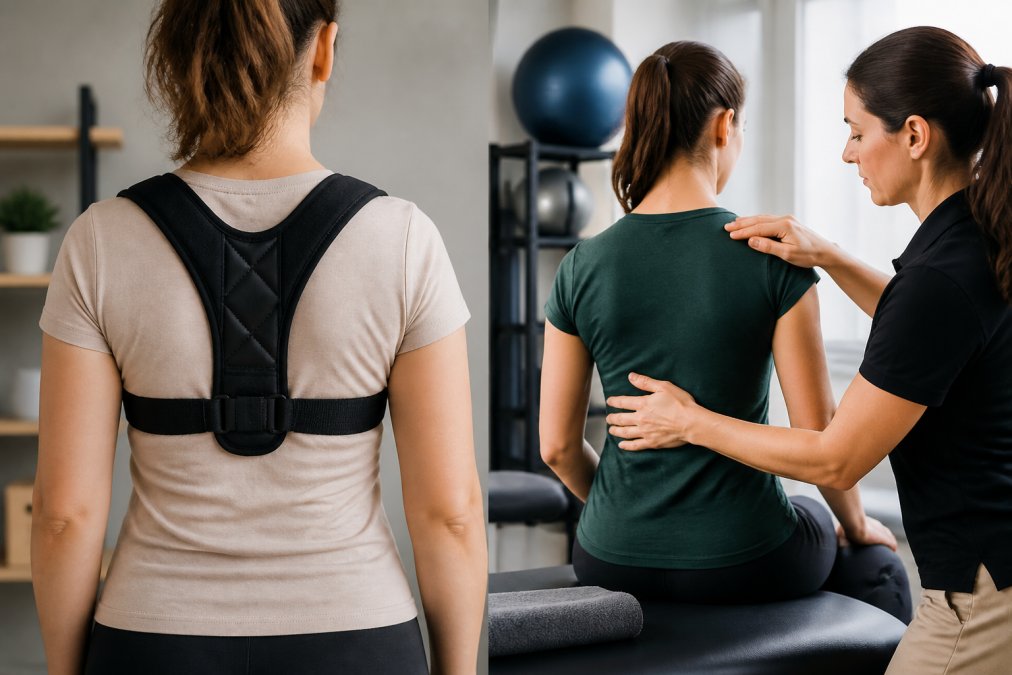
Posture corrector braces vs physical therapy is not a contest with a single winner. A posture corrector is a wearable device that pulls the shoulders back and cues spinal alignment, while physical therapy is a supervised program of therapeutic exercise and manual therapy that builds the strength to hold that alignment on its own. Braces change how you feel in the moment, and physical therapy changes what your body can do over time. (Source: a 2023 report by the Bureau of Labor Statistics)
| Approach | What It Does | Cost Model | Best For |
|---|---|---|---|
| Physical therapy | Builds strength and mobility | Per-session clinical fee | Chronic pain, structural issues |
| Posture corrector brace | Cues alignment while worn | One-time purchase | Awareness and short-term support |
| Biofeedback device | Vibrates when you slouch | One-time purchase | Habit formation |
The Root Cause of Poor Posture: Why It Matters for Treatment
The root cause of poor posture is rarely a single bad habit. It is usually a pattern: prolonged sitting shortens some muscles, weakens others, and trains your nervous system to accept a slouched position as normal. This is a muscle imbalance, not a character flaw.
Common contributors include:
- Sustained desk work with a forward head posture
- Weak core stabilization and inactive glutes
- Reduced proprioception, meaning less awareness of where your body sits in space
- Prior injury that altered your movement patterns
How Long to Wear a Posture Corrector: Guidelines and Risks
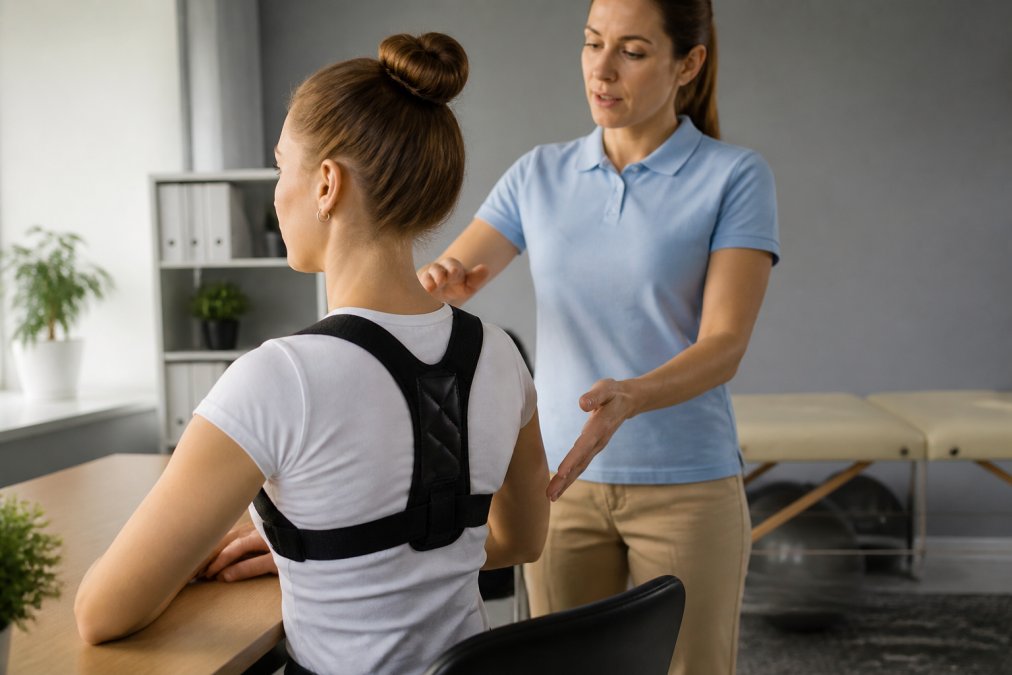
How long to wear a posture corrector depends on your goal, but the framing that matters most is this: a brace is a training cue, not a treatment. Most practitioners find that short, structured sessions beat all-day wear, and the schedule should be built around a weaning plan from day one, not treated as an open-ended habit.
A Structured Weaning Schedule
Instead of asking “how many hours,” ask “how do I need this device less each week?” A common pattern looks like this:
- Week 1, Awareness only. Wear the brace 15-20 minutes, once or twice a day, during a task where you slouch most (usually desk work). The goal is to feel what neutral alignment is, not to be supported through your whole day.
- Week 2, Cued practice. Same 15-20 minute blocks, but now you actively hold the position the brace is cueing. When you remove it, immediately do 5-10 reps of a scapular retraction or chin tuck to reinforce the pattern without the strap.
- Weeks 3-4, Alternating blocks. Wear the brace for one work block, then go without it for the next block while doing the same task. This is where most people discover whether the brace taught them anything or just propped them up.
- Weeks 5-6, Brace as a spot tool. Reserve it for long drives, heavy lifting days, or flare-ups. Daily wear should be dropping, not holding steady.
- Week 7 onward, Retire or reassess. If posture still collapses the moment the brace comes off, the brace was compensating for a strength deficit that only active work will fix. That is the signal to get a movement assessment rather than buy a tighter brace.
Why Over-Reliance Backfires
The risk of overuse is mechanical, not moral. A brace supports the shoulder girdle externally; it does not load the deep spinal stabilizers, scapular retractors, or core musculature that hold the vertebral column upright. When those muscles are never challenged, they adapt to the reduced demand, the same disuse principle that atrophies a limb in a cast. The tell is simple: if you slouch more than usual in the hour after removing the brace, you have been outsourcing the work.
Contraindications: When a Brace Can Make Things Worse
This is where general advice fails people, because “poor posture” is not one condition. A brace that helps one spine can aggravate another:
- Scoliosis: A lateral curvature is a three-dimensional problem. A generic shoulder-strap corrector pulls symmetrically and does nothing for the rotational component; in some curves it can reinforce compensatory patterns. Scoliosis bracing, when indicated, is a prescribed, custom-molded orthosis managed by a specialist, not an over-the-counter posture strap.
- Hyperkyphosis (excessive thoracic rounding): A rigid brace may feel supportive, but if it holds the spine in a position the surrounding muscles cannot actively maintain, it can accelerate the weakness that caused the kyphosis.
- Cervical issues and forward head posture: Braces that pull the shoulders back can push the head further forward if the wearer compensates, loading the cervical spine.
- Recent injury, surgery, or osteoporosis: Any structural fragility or healing tissue needs a clinician’s clearance before external bracing.
Wearing a rigid brace for most of the day can weaken the very muscles you are trying to train. If you notice you slouch more than usual right after removing it, you have been leaning on it too heavily, and if you have a diagnosed spinal condition, get clearance before bracing at all.
Track your brace minutes the way you would track a workout. If the number is not trending down over six to eight weeks, the brace has become a crutch rather than a cue.
Physical Therapy Exercises for Posture: Building Active Support
Physical therapy exercises for posture target the muscles that hold you upright, so the correction comes from inside rather than from a strap. A well-designed program usually pairs strengthening with mobility work.
Sample Exercise Progression for Posture Correction
A typical progression moves from awareness to strength to integration. Your therapist will adjust the pace to your body.
Start your wellness journey today! →
- Weeks 1-2, Awareness: Chin tucks and shoulder rolls to restore postural awareness and gentle range of motion.
- Weeks 3-4, Activation: Band pull-aparts and prone Y-raises to wake up the mid-back and shoulder girdle.
- Weeks 5-6, Strengthening: Rows, dead bugs, and plank variations for core stabilization.
- Weeks 7-8, Integration: Functional movement drills that carry good alignment into daily tasks.
Costs and Time Commitments: Braces vs Physical Therapy
Costs and time commitments differ sharply between the two, and the honest comparison is not “cheap gadget versus expensive clinic.” It is a one-time purchase against a course of care, and the math only favors the brace if the brace actually solves the problem.
The Cost Models Side by Side
| Factor | Posture corrector brace | Physical therapy |
|---|---|---|
| Payment structure | One-time retail purchase | Per-visit clinical fee, billed per session |
| Typical out-of-pocket range | Low, one-time (varies widely by device) | Higher per visit; total depends on visit count |
| Insurance | Generally not covered, it is a retail consumer product | Often partially covered when medically necessary; depends on plan and diagnosis |
| Time cost | Minutes per day | Weeks of sessions plus daily home exercise |
| What you are paying for | A cue you wear | Assessment, manual therapy, and a progressive program |
| Failure mode | You keep buying tighter braces | You stop doing the home program |
The Cost-Benefit Question Nobody Asks
The real financial comparison is not the sticker price, it is cost per unit of lasting change. A brace that costs very little but delivers no durable correction is the most expensive option on the board, because you buy it, use it, plateau, and then pay for physical therapy anyway. A course of physical therapy costs more up front but is designed to end: the goal is discharge, with a home program you own.
A useful way to frame it:
- If your posture issue is a habit and an awareness gap, you slouch because you do not notice, and you have no pain, a brace plus ergonomic changes may be a reasonable low-cost first step.
- If you have pain, numbness, tingling, or a diagnosed spinal condition, the brace-only path tends to cost more over time, because the underlying cause is never addressed and symptoms recur.
- If you have tried braces for several weeks without improvement, additional brace spending is unlikely to change the outcome. That money is better directed at an assessment.
Insurance and Coverage Realities
Physical therapy is a covered benefit under many health plans when it is medically necessary and ordered appropriately, though coverage, visit limits, copays, and referral requirements vary by plan. Posture corrector braces are consumer products and are generally not covered. Before committing to either path, check your plan’s physical therapy benefit, whether a referral is required, and what your per-visit responsibility would be, that single phone call often decides the comparison more than the retail price of a brace does.
The Time Trade-Off
A brace asks minutes of your day. Physical therapy asks weeks of consistent effort, plus the discipline to do home exercises between visits. For many people the deciding factor is not money but whether the underlying cause is being addressed at all, and that is the question a price tag cannot answer.
Ask any provider how they measure progress before you commit. A clinic that tracks range of motion, strength, and functional movement gives you objective proof that the plan is working, not just a feeling that it might be.
When to See a Physical Therapist for Posture Correction
See a physical therapist when posture problems come with pain, numbness, tingling, or symptoms that persist despite rest and ergonomic changes. Those signs suggest the issue has moved beyond a habit and into something that needs assessment.
Frequently Asked Questions
What are the downsides of using a posture corrector?
Posture correctors can provide temporary relief by reminding you to sit up, but they don’t address underlying muscle weakness. Prolonged use may lead to muscle atrophy because your muscles become dependent on the brace. They can also cause discomfort, skin irritation, or restrict movement. For lasting results, they should be combined with active rehabilitation like physical therapy exercises for posture.
Do chiropractors recommend posture correctors?
Many chiropractors view posture correctors as a short-term tool rather than a long-term solution. They may recommend them for a few hours a day to build postural awareness, but emphasize that without strengthening the supporting muscles, the root cause of poor posture remains. A holistic approach often includes manual therapy, therapeutic exercise, and ergonomic adjustments.
Can physical therapy provide permanent solutions for poor posture?
Physical therapy aims to correct muscle imbalances and improve movement patterns through customized exercise programs. While it can lead to lasting improvements, results depend on consistency and addressing contributing factors like ergonomics and daily habits. Many people experience significant, long-term relief when they actively participate in their rehabilitation.
Is a posture corrector a substitute for professional medical treatment?
No, a posture corrector is not a substitute for professional evaluation and treatment, especially if you have chronic pain or structural issues. It can serve as a reminder, but conditions like thoracic kyphosis or forward head posture often require a tailored plan from a physical therapist or chiropractor. Always consult a qualified professional for persistent symptoms.