
Last Updated: October 25, 2026
Quick Summary
To improve office air quality for wellness, ensure your HVAC system exchanges at least 15 cubic feet per minute of fresh air per person, replace filters every 1-3 months using MERV 11 filters, and remove blockages around vents to maintain proper airflow. These steps reduce headaches, fatigue, and difficulty concentrating caused by poor indoor air quality.
- HVAC filters should be replaced every 1-3 months depending on dust and activity levels in your space.
- MERV 11 filters provide good balance between capturing particles and maintaining airflow for most offices.
- HEPA air purifiers capture 99.97% of particles 0.3 microns or larger and work best in enclosed spaces.
- Keep humidity between 30-50% to prevent mold growth and maintain healthy indoor air.
- Open windows for 15-30 minutes in warmer months to provide natural ventilation and flush out stale air.
Table of Contents
- Recognize Signs of Poor Indoor Air Quality at Work
- Assess Your Current Office Ventilation and Fresh-Air Exchange
- Office Ventilation Best Practices for Healthy Airflow
- Select and Maintain HVAC Filters and Air Purification Systems
- How Often to Run an Air Purifier in an Office
- Control Allergens and Indoor Pollutant Sources
- Create an Indoor Air Quality Checklist for Offices
- Monitor and Measure Your Progress
- Frequently Asked Questions
Recognize Signs of Poor Indoor Air Quality at Work
To improve office air quality at work, you first need to recognize how poor air quality often shows up in ways you might not immediately connect to the office environment. If you’re experiencing headaches, fatigue, or difficulty concentrating during the workday, the air around you could be the culprit.
Common signs of poor indoor air quality include:
- Headaches or migraines that start mid-morning
- Dry eyes, nose, or throat
- Unexplained fatigue or brain fog
- Coughing or wheezing without being sick
- Difficulty concentrating or staying alert
- Stuffy, stale-smelling air in your workspace
These symptoms often develop gradually, so you might not notice them until they’ve become part of your routine. The problem is that poor indoor air quality compounds over time. Dust, allergens, volatile organic compounds from office equipment, and inadequate ventilation all accumulate throughout the day.
At Holistic & Wellness Medicine, we work with office workers who’ve struggled with these exact symptoms and discovered that efforts to improve office air quality have a ripple effect on their overall wellness. Many discover that improving their workplace air quality has a ripple effect on their overall wellness.
If you’re experiencing any of these signs, the next step is to assess what’s actually happening with your office ventilation and fresh-air exchange.
Assess Your Current Office Ventilation and Fresh-Air Exchange

Start by observing your office environment. How often do you notice windows being opened? Does the air feel stale or stuffy? These observations matter because ventilation is the foundation of indoor air quality.
Most office buildings rely on HVAC systems to manage airflow. Your HVAC system should be exchanging indoor air with fresh outside air regularly.
To assess your current situation, ask yourself these questions:
- Can you open windows in your workspace?
- How long has it been since the HVAC filters were last replaced?
- Do you notice odors or stuffiness in certain areas?
- Are there visible dust buildup on vents or surfaces?
- Does your office feel different in summer versus winter?
Walk around your office and look for HVAC vents. They should feel like air is moving through them. If vents are blocked by furniture, equipment, or clutter, that disrupts the airflow pattern your building was designed for.
Check whether your building has a maintenance schedule for the HVAC system. If you don’t know, ask your facility manager or building management. They can tell you when filters were last changed and whether the system is performing as intended.
Office Ventilation Best Practices for Healthy Airflow
Healthy airflow requires intentional design and maintenance. The goal is to keep fresh air moving through your workspace while removing stale air, dust, and contaminants. This isn’t complicated, but it does require attention.
Create pathways for air circulation. Position desks and furniture to avoid blocking vents. If your workspace has windows, keep them accessible so air can move naturally when opened.
Open windows strategically. When outdoor air quality is good, opening windows provides natural ventilation that no mechanical system can fully replicate.
Manage seasonal differences. Winter air tends to be drier because heating systems reduce humidity. Summer air may bring in pollen and outdoor pollution. Your office ventilation strategy should shift with the seasons.
Coordinate with your HVAC system. If your office has a central HVAC system, ask your facility manager about the fresh-air intake settings.
Monitor air movement. You can feel air movement with your hand near vents. If you feel nothing, mention it to maintenance. Blocked filters, disconnected ducts, or equipment failures prevent proper airflow.
Select and Maintain HVAC Filters and Air Purification Systems
Your HVAC filter is your first line of defense against airborne particles. The filter traps dust, pollen, pet dander, and other contaminants before they circulate through your office.
Understand MERV ratings. MERV stands for Minimum Efficiency Reporting Value (the EPA). It rates how effectively a filter removes particles from air. MERV ratings range from 1 to 16. Higher numbers capture smaller particles.
- MERV 8-11: Captures larger particles like dust and pollen. Standard for most offices.
- MERV 12-13: Captures smaller particles including some bacteria and smoke. Better for offices with allergies or respiratory concerns.
- MERV 14-16: Hospital-grade filtration. Rarely needed in office settings.
For most office environments, a MERV 11 filter provides a good balance between filtration and airflow. Higher MERV ratings restrict airflow more, which can strain your HVAC system if it wasn’t designed for them.
Replace filters on schedule. Check your filter every month. If it looks gray or clogged with dust, it’s time to replace it.
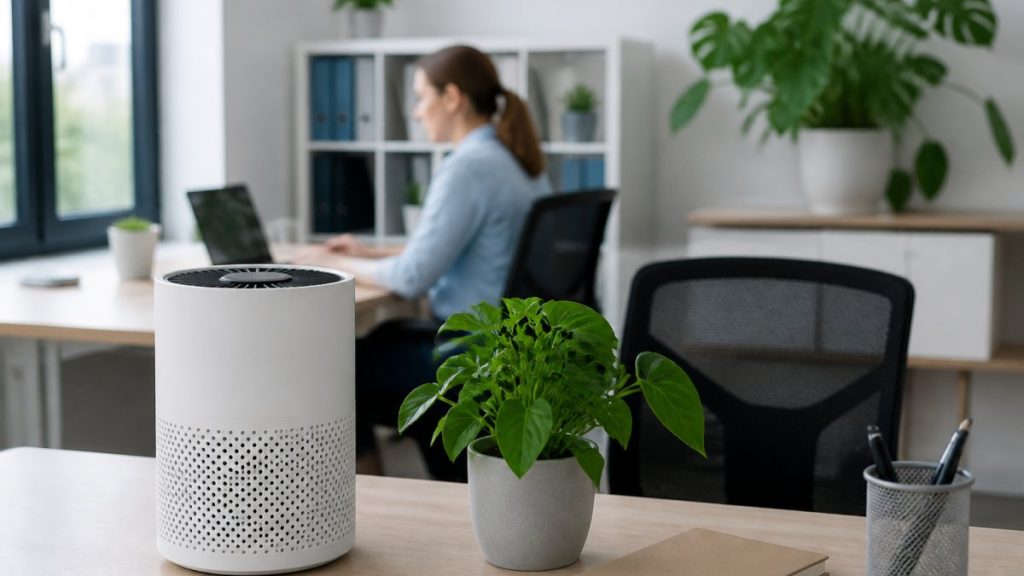
Consider supplemental air purifiers. If your office has persistent air quality issues, a standalone air purifier can help. Look for purifiers with HEPA filters, which capture 99.97% of particles 0.3 microns or larger (the EPA).
Air purifiers work best in enclosed spaces. A purifier in a large, open office may not reach all areas effectively.
How Often to Run an Air Purifier in an Office
Running an air purifier continuously provides the most consistent air quality improvement. If your purifier is energy-efficient, continuous operation is practical and cost-effective.
However, you can optimize purifier use based on occupancy and activity. Run purifiers at full speed during peak office hours when more people are present and generating more dust and particles. You can reduce speed or run on lower settings during lunch hours or when fewer people are working.
Start your wellness journey today! →
Some offices run purifiers during after-hours to prepare for the next day. This can help clear accumulated particles from the previous day before employees return.
The key is consistency. Intermittent operation is less effective than regular, predictable use. Your purifier needs time to cycle air through the filter multiple times to remove particles effectively.
Control Allergens and Indoor Pollutant Sources
Indoor pollutants come from many sources. Controlling them means identifying where they come from and reducing them at the source.
Dust and particles. Dust accumulates on surfaces, in carpets, and in air ducts. Regular cleaning reduces dust that becomes airborne. Vacuum carpeted areas with HEPA filters.
Cleaning products. Many conventional cleaning products release volatile organic compounds (VOCs) that degrade indoor air quality. Natural cleaning products or products labeled low-VOC are better choices. Vinegar and water work for many surfaces. Baking soda absorbs odors without releasing chemicals.
Office equipment. Printers, copiers, and electronics emit particles and VOCs. Ensure these are in well-ventilated areas. If possible, locate high-use equipment away from where people spend the most time.
Allergens. If your office has carpet, it traps allergens like dust mites and pet dander. Hard flooring is easier to keep clean. Plants can improve air quality, but they also accumulate dust.
Moisture and mold. Excess humidity promotes mold growth. Keep humidity between 30-50%. If you notice musty odors or visible mold, report it immediately. Mold indicates a moisture problem that needs fixing.
Create an Indoor Air Quality Checklist for Offices
A systematic approach helps you track progress and ensure nothing gets overlooked. Use this checklist to evaluate and improve your office air quality:
| Task | Frequency | Responsibility |
|---|---|---|
| Check HVAC filter condition | Monthly | Facilities or designated staff |
| Replace HVAC filter | Every 1-3 months | Facilities or building maintenance |
| Inspect vents for blockage | Monthly | Office staff or facilities |
| Clean air purifier filters | Per manufacturer | Office staff |
| Dust surfaces and vents | Weekly | Cleaning staff |
| Vacuum with HEPA filter | Weekly | Cleaning staff |
| Check humidity levels | Monthly | Facilities or facilities manager |
| Inspect for mold or moisture | Monthly | Facilities or building manager |
| Assess air circulation | Quarterly | Facilities manager |
| Review ventilation settings | Quarterly | HVAC technician or facilities |
You can also create a simple wellness check. Once monthly, ask your team: How’s the air quality feeling? Any new symptoms? This qualitative feedback often catches problems before they become severe.
For office workers looking to integrate air quality into a broader wellness strategy, explore integrated wellness approaches for office workers that address how your physical environment supports your overall health.
If you’re ready to build a comprehensive plan that includes air quality alongside other wellness factors, learn how to start a personalized wellness plan that fits your schedule and goals.
Monitor and Measure Your Progress
Tracking air quality changes helps you understand what’s working. You don’t need expensive equipment to do this effectively.
Start with simple observations. Keep a brief log of how you feel during the workday. Note energy levels, headaches, respiratory symptoms, or brain fog.
If you want more precise measurement, consider a basic air quality monitor. These devices measure particulate matter (PM2.5 and PM10) and sometimes CO2 levels.
CO2 levels indicate how well your office is exchanging fresh air. Levels above 1,000 ppm suggest inadequate ventilation. Readings below 800 ppm indicate good fresh-air exchange.
Share your findings with your facilities team. If you’ve measured improvements after filter changes or ventilation adjustments, that data helps justify continued investment in air quality.
The connection between indoor air quality and overall wellness is direct.
At Holistic & Wellness Medicine, we see how environmental factors like air quality interact with posture, movement, and stress. When you improve your office air quality alongside other wellness practices, you create conditions for real, lasting improvement. Learn more about integrated wellness strategies tailored to busy professionals who want to address their environment as part of their health foundation.
The path to better wellness starts with the air you breathe. Take one step this week: check your HVAC filter, open a window, or talk to your facilities team about air quality.
Frequently Asked Questions
What are the main signs of poor indoor air quality at work?
Common signs include persistent headaches, fatigue, difficulty concentrating, dry throat or eyes, and worsening of allergies or asthma symptoms during work hours. Stuffy air, visible dust, or lingering odors from cleaning products, equipment, or exhaust emissions also indicate poor air quality. If symptoms improve when you leave the office, indoor air quality may be the culprit. Document when symptoms occur to identify patterns related to specific times or areas.
How often should you run an air purifier in an office?
Run your office air purifier continuously during all business hours for consistent filtration of airborne particles and contaminants. If your office has high occupancy, poor ventilation, or nearby pollution sources, 24/7 operation may be necessary. Adjust based on air-quality monitoring readings and employee health responses. Check the manufacturer’s recommendations for your specific unit, as filter lifespan and energy efficiency vary. Running it intermittently is less effective than continuous operation for maintaining healthy indoor air quality.
What does OSHA require for office air quality?
OSHA requires employers to provide a workplace free from recognized hazards that cause or are likely to cause death or serious physical harm, including poor indoor air quality. While OSHA does not set specific indoor air quality standards, it enforces compliance with ventilation codes in building standards and addresses complaints about indoor air quality that affect employee health. Employers must maintain HVAC systems, ensure adequate fresh-air exchange, and address indoor pollutants. Consult OSHA guidelines and your local building codes for specific ventilation rates and requirements.
Can an air purifier alone improve workplace air quality?
An air purifier helps remove airborne particles and some contaminants, but it works best as part of a comprehensive approach. Ventilation, HVAC maintenance, filter replacement, allergen control, and cleaning practices are equally important. Air purifiers cannot replace fresh-air exchange or address pollutant sources like cleaning products or equipment emissions. For optimal results, combine air purifier use with improved ventilation, regular HVAC maintenance, and reduced indoor pollutant sources to create a healthier office environment.
Better office air quality is achievable with focused attention to ventilation, filtration, and pollutant control. Start with assessment, move to implementation, and track your results. Your body will tell you when the air around you is supporting your wellness instead of working against it.