
Table of Contents
- Why Combine Chiropractic Care and Yoga? The Synergy Explained
- Chiropractic Care for Yoga Practitioners: What to Expect
- Yoga Poses for Spinal Alignment and Posture Correction
- Preventative Care for Chronic Back Pain: Building Long-Term Resilience
- Contraindications and Safety Precautions You Should Know
- How to Integrate Chiropractic and Yoga: A Practical Timeline
- What the Research Says About Chiropractic and Yoga
- Frequently Asked Questions
Last Updated: September 12, 2026
Why Combine Chiropractic Care and Yoga? The Synergy Explained
The benefits of combining chiropractic care and yoga come from treating two halves of the same problem: the joint restriction a chiropractor addresses and the muscle patterns that caused it. An adjustment restores motion to a locked segment, but if the surrounding muscles stay tight and the daily posture that created the restriction never changes, the joint drifts right back.
That is why so many people cycle through adjustments without lasting relief. The adjustment is not the failure. The missing piece is the homework.
Chiropractic care is a hands-on, non-invasive approach to restoring joint mobility and reducing interference in the nervous system, most often through spinal adjustment. Yoga is a movement practice that builds flexibility, core stability, and body awareness. Put them together and one corrects the joint while the other retrains the muscles and movement habits around it.
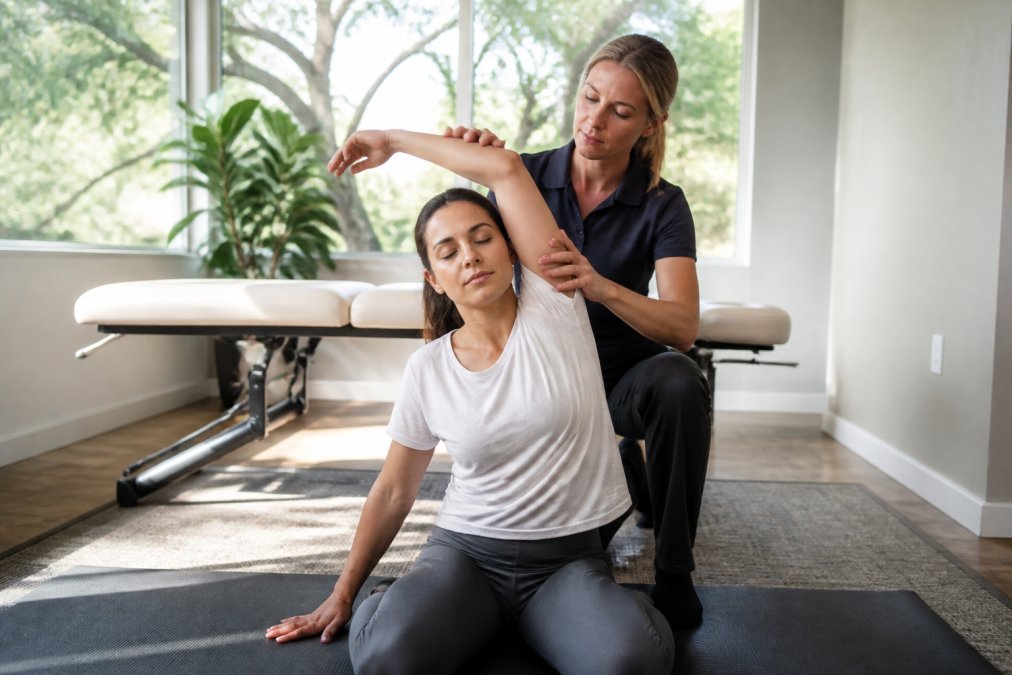
The two practices also work on different timelines. An adjustment gives immediate input to joint mobility and nervous system function, while yoga builds range of motion and muscular support over weeks. Paired, patients tend to hold their progress longer than with either approach alone. Below, we break down what each contributes, which poses matter, who should be cautious, and how to sequence the two.
Chiropractic Care for Yoga Practitioners: What to Expect
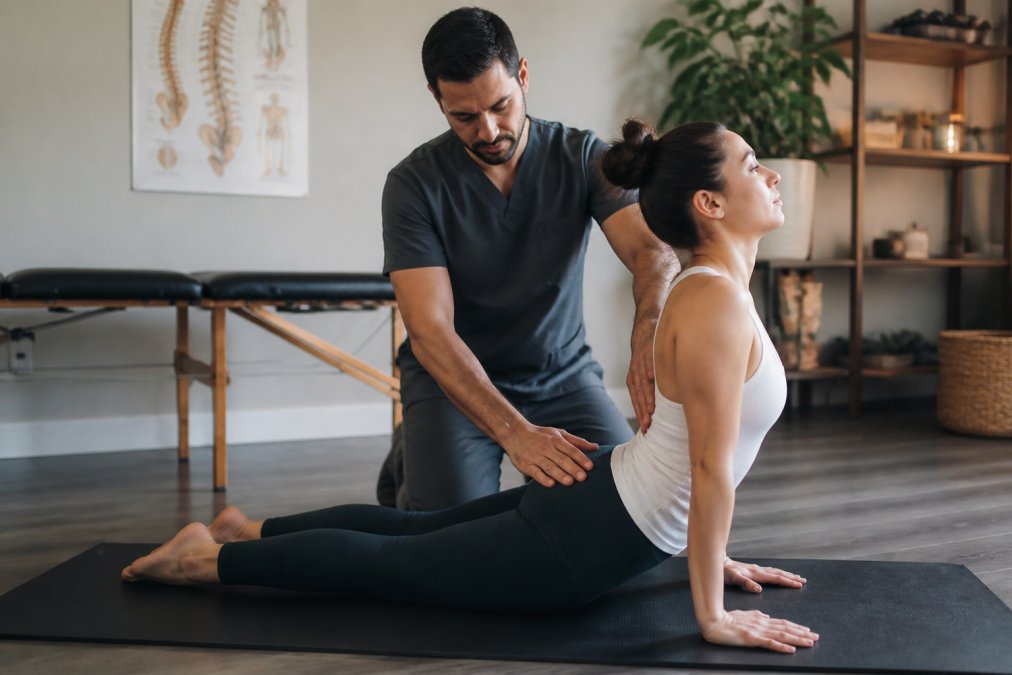
Chiropractic care for yoga practitioners looks different from a standard visit, because the goal is not just relief, it is better movement on the mat. A chiropractor assesses where your spine and joints are restricted, then adjusts those segments to restore motion.
Your first visit typically includes a health history, a postural and movement assessment, and a discussion of your practice. Tell your chiropractor which poses feel stuck. A tight thoracic spine shows up as a shallow backbend. A restricted hip shows up as a twisted triangle. Those details shape the treatment plan.
A few things worth knowing before you go:
- Adjustments are usually quick, and many people feel looser immediately
- Some soreness for a day or two afterward is common and typically mild
- You may be given simple mobility drills to do between visits
- Deep backbends and intense twists are usually best avoided right after an adjustment
Schedule your yoga session for the day after an adjustment, not the same day. The joint has new range, and the following day’s practice is where you teach your muscles to use it.
Yoga Poses for Spinal Alignment and Posture Correction
Yoga poses for spinal alignment work best when they are matched to the segment that is actually restricted, not chosen because they look impressive on a mat. A chiropractor can tell you which region is locked, cervical, thoracic, lumbar, or sacroiliac, and that finding should drive which poses you prioritize. The goal is not to force a shape, but to restore motion the spine already should have and teach the surrounding muscles to hold it.
Below are the poses most commonly assigned to chiropractic patients, grouped by the problem they address, with the specific cue that makes each one work.
For a stiff thoracic spine (the desk-work problem)
A rounded upper back pulls the head forward and makes every backbend feel like it is happening in the lower back instead of the mid-back. These three restore extension and rotation where it belongs.
- Cat-Cow, move one vertebra at a time rather than hinging at the waist. Ten slow rounds as a warm-up before anything else.
- Thread the Needle, from hands and knees, slide one arm under the body and rest the shoulder and ear on the mat. Hold 5-8 breaths per side. This is the single most useful pose for the rotation most desk workers lose.
- Supported Fish over a rolled blanket placed horizontally under the shoulder blades, 2-3 minutes. The blanket does the work so you do not have to force the backbend.
For lumbar support and lower-back decompression
- Child’s Pose, knees wide, hips back toward the heels, arms extended. If the lower back rounds uncomfortably, place a bolster or folded blanket under the torso so the spine can lengthen instead of compress. Hold 1-3 minutes.
- Supine Knee-to-Chest, one knee at a time, then both. This is gentler than it looks and is often the first pose a chiropractor clears after an acute episode.
- Sphinx, forearms down, elbows under the shoulders, hips on the mat. A gentle, controlled extension that loads the lumbar spine far less than a full Cobra or Wheel.
For core stability and sacroiliac support
- Bird Dog, extend the opposite arm and leg while keeping the pelvis level. The point is not how high the limbs go; it is whether the hips stay square. Five reps per side, holding 3-5 seconds.
- Dead Bug, on the back, arms up, knees over hips, lower one arm and the opposite leg while keeping the lower back pressed into the mat. This is the pose that most reliably transfers to daily lifting mechanics.
- Glute Bridge, heels close to the hips, press up through the feet, squeeze the glutes at the top. Strong glutes take load off the sacroiliac joint and the lower back.
For hamstring length and posterior chain
- Downward-Facing Dog, the common mistake is rounding the lower back to get the heels down. Keep a long, neutral spine and let the knees bend as much as they need to. Heels reaching the floor is not the goal; a straight spine is.
- Standing Forward Fold with bent knees, hands on blocks if needed. This lengthens the hamstrings without asking the lumbar spine to flex under load.
How to sequence them
A practical order for a chiropractic patient is: warm-up (Cat-Cow), mobility (Thread the Needle, Child’s Pose), stability (Bird Dog, Dead Bug, Glute Bridge), then length (Downward-Facing Dog, forward fold). Twists and backbends go in the middle, so the stabilizing work finishes the session and reinforces the new range.
Ask your chiropractor to circle the two or three poses that match your specific restriction. A short, targeted practice you repeat daily beats a long, generic flow you do once a week.
Do not push into a pose that produces sharp pain, numbness, or tingling down a limb. That is a signal to stop and get assessed, not to stretch harder. Skip inversions, deep backbends, and forceful twists if you have an acute disc issue, recent spinal surgery, or severe osteoporosis until a clinician clears them.
Preventative Care for Chronic Back Pain: Building Long-Term Resilience
Preventative care for chronic back pain is less about chasing the next fix and more about building a body that does not re-injure. Most recurring back pain has a mechanical driver: a stiff segment, a weak core, or a movement pattern that loads one area repeatedly.
The pattern we see most often is a patient who gets adjusted, feels better, stops everything, and returns in six weeks with the same complaint. The adjustment worked. The maintenance plan did not exist.
A workable long-term approach combines three things:
- Regular movement – a short daily practice beats one long weekly session
- Periodic check-ins – adjustments when motion starts to restrict again, not only when pain returns
- Load management – building core and hip strength so the spine is not doing all the work
This is where an integrated approach earns its keep. Chiropractic care keeps the joints moving. Yoga builds the strength and flexibility that protect them. Neither one alone addresses both sides of the equation.
Contraindications and Safety Precautions You Should Know
Combining the two is generally safe for most healthy adults, but there are real situations where you should pause and get clearance first.
Start your wellness journey today! →
Talk to a qualified professional before starting either practice if you have:
- A recent fracture, spinal surgery, or unstable spinal condition
- Severe osteoporosis or a known bone-weakening condition
- Acute disc herniation with significant nerve symptoms
- Pregnancy, particularly in the later stages
- An acute injury with swelling, or unexplained severe pain
Inversions, deep backbends, and forceful twists are the poses most likely to cause trouble for people with these conditions. A qualified instructor can offer modifications, and a chiropractor can tell you which movements to avoid while you heal.
Nobody should diagnose themselves from an article. If something feels wrong, get evaluated.
How to Integrate Chiropractic and Yoga: A Practical Timeline
A realistic integration plan starts slow and adds load only as your body tolerates it. Rushing is the most common mistake we see. But the question most people actually search for is more specific than “how long does it take”, it is when to schedule each session relative to the other. That sequencing determines whether the two practices reinforce each other or fight each other.
The session-level rule: adjust first, practice second
An adjustment restores motion to a joint that was restricted. The muscles around that joint have adapted to the restriction and will, for a short window, try to pull it back. Yoga done in that window teaches the muscles to accept and use the new range. Yoga done before an adjustment does the opposite, it works the muscles around a joint that is still locked, which is why some people feel stiff and sore after a class and then dramatically better after an adjustment.
A workable default:
- Adjustment day: light mobility only (Cat-Cow, Child’s Pose, gentle walking). No deep backbends, no intense twists, no long holds.
- The day after an adjustment: this is the highest-value practice day. The joint has new range and the tissue is ready to be trained into it. Do your full targeted sequence here.
- Two to three days after: normal practice, adding load or complexity as tolerated.
- Right before the next adjustment: a gentle session is fine, but do not exhaust the muscles you are about to ask to hold a new position.
The phase timeline
| Phase | Focus | Frequency | What to Watch For |
|---|---|---|---|
| Weeks 1-2 | Gentle mobility only, adjustment day = rest day | 10 min daily, 1 adjustment | Soreness that fades within a day |
| Weeks 3-4 | Add core stability work (Bird Dog, Dead Bug, Glute Bridge) | 3-4 sessions weekly, adjustments every 1-2 weeks | Steady range-of-motion gains |
| Weeks 5-8 | Full targeted practice plus adjustments | 4-5 sessions weekly, adjustments every 2-3 weeks | Progress that holds between visits |
| Ongoing | Maintenance | Daily movement, periodic check-ins | Early signs of restriction returning |
How to know it is working
The signal that the plan is working is not that you feel great the day of an adjustment, that happens with an adjustment alone. The signal is that the range holds between visits. If you are still tight by day four or five, the yoga piece is either too light, too inconsistent, or aimed at the wrong segment. That is a conversation with your chiropractor, not a reason to add intensity.
Pair this with realistic expectations. If you cannot commit to daily practice, a 10-minute routine you actually do beats a 60-minute routine you skip. Start with the schedule you can keep, then build.
The sequence matters more than the intensity. Adjust first, practice second, and give the muscles time to learn the new range before you push it. The day after an adjustment is the most productive practice day you have.
What the Research Says About Chiropractic and Yoga
The evidence base for each practice separately is more established than for the combination, and it is worth being honest about that. Research on [spinal manipulation for low back pain(https://holisticandwellnessmedicine.com/chronic-pain-management-treatment-options/) | nccih.nih.gov] has examined chiropractic adjustment for years, and clinical guidelines from bodies such as the American College of Physicians list spinal manipulation among the non-invasive options for low back pain. Yoga has its own body of research, including NCCIH’s overview of yoga for health, which notes its use for back pain and stress.
What is less studied is the two together as a formal protocol. That gap means the combination is under-researched, not unproven. The logic is sound: one approach addresses joint restriction, the other the muscular and movement patterns around it, so chronic pain management targets both the symptom and its mechanical driver.
Treat it as a reasonable, low-risk addition to a broader plan, not a guaranteed cure, and ask your provider what the realistic timeline looks like for your specific issue.
Chronic pain rarely has a single cause, which is why single-approach fixes so often fade. Holistic & Wellness Medicine brings chiropractic care, massage therapy, functional medicine, and yoga under one roof, so your adjustment and your movement plan are designed by a team that talks to each other. We start with a root cause assessment rather than a symptom checklist, then build a plan around your schedule and your goals. If you have cycled through treatments that never quite held, start your wellness journey today and find out what an integrated approach can do differently.
Frequently Asked Questions
Can yoga help maintain the results of a chiropractic adjustment?
Yes. Yoga complements chiropractic care by strengthening the muscles that support spinal alignment. After an adjustment, targeted poses like Cat-Cow and Child’s Pose help maintain joint mobility and reduce the likelihood of misalignment returning. Many practitioners find that combining both approaches supports longer-lasting results than adjustments alone.
Is it safe to practice yoga immediately after a chiropractic session?
It depends on the adjustment and your body’s response. Some people feel fine doing gentle stretching right away, while others need 24 to 48 hours before more active movement. Talk to your chiropractor about which poses are appropriate and when to resume your normal yoga routine safely.
What do chiropractors think of yoga?
Many chiropractors view yoga as a helpful complement to adjustments. Yoga supports flexibility, core stability, and stress reduction, all of which can enhance chiropractic outcomes. The key is choosing poses that match your current mobility and avoiding movements that aggravate existing injuries.
Can yoga poses help prevent common musculoskeletal misalignments?
Regular yoga practice can improve muscle balance and posture, which may reduce the frequency of misalignments. Poses that strengthen the core and stretch tight hip flexors or hamstrings help keep the spine supported. Combined with periodic chiropractic check-ups, this approach supports preventative care for chronic back pain.


5 Natural Remedies for Anxiety and Stress at Home
Discover 5 natural remedies for anxiety and stress at home, from breathing exercises to herbal supplements. Learn how functional medicine can help. Start.

How to Improve Posture to Reduce Pain: A 2026 Guide
Learn how to improve posture to reduce pain with exercises, stretches, and ergonomic tips. Discover a holistic approach to lasting relief. Start today.

How to Treat Adrenal Fatigue Without Medication
Learn how to treat adrenal fatigue without medication using diet, stress management, and natural supplements. Discover practical steps to restore.