
Table of Contents
- What Is Integrated Chiropractic Care?
- Chiropractic Care for Chronic Pain Management
- How Chiropractic and Physical Therapy Integration Works
- Key Benefits of Integrated Chiropractic Care
- How Long Does Integrated Chiropractic Treatment Take?
- Why Integrated Care Outperforms Siloed Treatment
- Conclusion
Last Updated: August 6, 2026
What Is Integrated Chiropractic Care?
Integrated chiropractic care is a coordinated approach to health that combines chiropractic treatment with other evidence-based therapies, such as physical therapy, massage, functional medicine, and yoga, to address the root causes of pain and dysfunction rather than just treating symptoms. Instead of seeing a chiropractor in isolation, patients work with a collaborative team where specialists communicate about treatment plans and adjust their approaches based on shared patient outcomes.
The difference between integrated chiropractic care and traditional chiropractic treatment comes down to scope and coordination. A patient might visit a chiropractor for spinal adjustments, but without integration, they’re left to coordinate separately with a physical therapist, massage therapist, or other providers. Integrated care eliminates that fragmentation. The chiropractor, physical therapist, and other practitioners share information, align their goals, and adjust their techniques based on what’s working.
This approach treats the body as an interconnected system rather than isolated problem areas. A patient with chronic lower back pain might discover through integrated assessment that the real issue isn’t just spinal misalignment, it’s poor posture from desk work, tight hip flexors, and stress-related muscle tension. An integrated team addresses all three simultaneously instead of each provider treating their piece independently.
At Holistic & Wellness Medicine in San Antonio, this collaborative model is central to how patient care works. Rather than referring patients elsewhere, the team coordinates in-house, meaning your chiropractor knows exactly what your massage therapist is working on and vice versa.
Chiropractic Care for Chronic Pain Management
Chronic pain, defined as pain lasting longer than 12 weeks, affects millions of Americans and often persists despite conventional treatments. Many people find that pain medications provide temporary relief but don’t address what’s causing the pain in the first place. Chiropractic care approaches chronic pain by focusing on spinal alignment, nerve function, and musculoskeletal balance.
When vertebrae become misaligned (a condition chiropractors call subluxation), they can irritate nearby nerves, restrict joint function, and trigger pain that radiates throughout the body. Spinal adjustments realign these vertebrae, reducing nerve irritation and restoring proper joint mechanics. For many patients with chronic lower back pain, neck pain, or headaches, this approach offers relief without surgery or long-term medication dependence.
The key advantage in chronic pain management is that chiropractic care is non-invasive. There are no injections, no prescription medications with side effects, and no surgical risk. Instead, treatment focuses on restoring function through hands-on techniques and therapeutic exercise. Patients often report that pain improves gradually as spinal health and range of motion improve.
However, chiropractic care alone doesn’t always fully resolve chronic pain. When integrated with physical therapy, patients gain the benefit of targeted rehabilitation exercises that strengthen supporting muscles and improve posture. This combination addresses both the immediate spinal issue and the underlying movement patterns that contributed to the problem in the first place.
How Chiropractic and Physical Therapy Integration Works
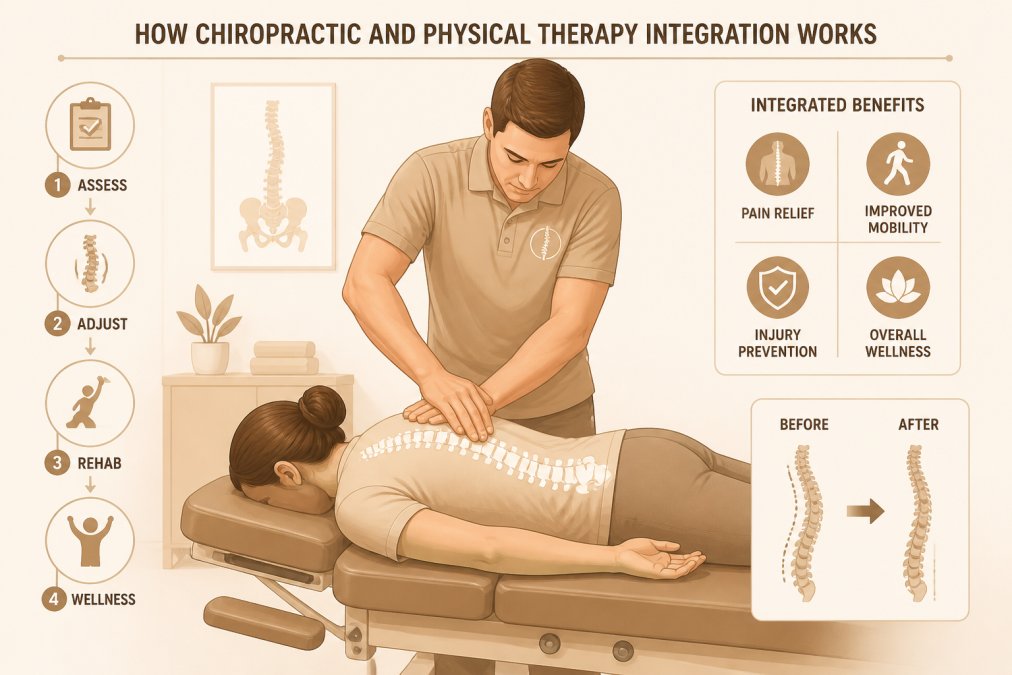
Chiropractic and physical therapy integration represents a multi-disciplinary approach where two distinct but complementary disciplines work toward the same patient outcome. Chiropractors focus on spinal alignment and joint function, while physical therapists specialize in therapeutic exercise, movement patterns, and functional rehabilitation. When coordinated, they create a complete treatment pathway.
Spinal Adjustments and Rehabilitation
Spinal adjustments restore proper vertebral alignment and improve nerve function, while rehabilitation builds the muscular support system that keeps the spine stable long-term. A chiropractor might perform an adjustment to restore joint mobility, and the physical therapist then teaches the patient exercises to strengthen the muscles that support that joint.
This sequence matters. An adjustment without follow-up rehabilitation often leads to the problem recurring because the underlying weakness remains. The patient leaves feeling better temporarily, but within weeks the vertebrae drift back out of alignment because the supporting muscles aren’t strong enough to maintain the correction. Integration solves this by ensuring that every adjustment is paired with a rehabilitation plan designed to make the improvement stick.
Many patients with chronic back pain experience this cycle repeatedly with traditional chiropractic care alone. Integrated care breaks the cycle by treating both the alignment issue and the functional weakness simultaneously. The adjustment addresses the immediate problem, and the rehabilitation prevents it from returning.
Coordinated Treatment Planning
In an integrated care model, the chiropractor and physical therapist develop a shared treatment plan rather than working independently. They communicate about what they observe, what’s improving, and what needs adjustment. If a patient’s pain isn’t responding as expected, the team problem-solves together instead of each provider assuming their approach should be sufficient.
This coordination extends to preventative care. Once acute pain resolves, the integrated team helps the patient understand what caused the problem and how to prevent recurrence. A patient might learn that their desk setup contributes to neck strain, or that their running form creates repetitive stress on their knees. The team addresses these root causes rather than waiting for pain to return.
Coordinated care also means more efficient treatment. Rather than attending separate appointments with overlapping goals, patients follow a simplified plan where each appointment builds on the previous one. This typically means faster recovery and fewer total visits than siloed treatment would require.
Key Benefits of Integrated Chiropractic Care

Improved Range of Motion and Joint Function
Integrated chiropractic care systematically restores the range of motion that pain and dysfunction restrict. When vertebrae misalign or joints become stiff, movement becomes limited and uncomfortable. Spinal adjustments restore joint mobility, while therapeutic exercises from physical therapy build the strength and flexibility needed to maintain that mobility.
The practical result is that patients regain the ability to move without pain. Someone who couldn’t bend forward to tie their shoes, or rotate their neck to look over their shoulder, gradually recovers those movements. This isn’t just about comfort, it’s about functional independence and quality of life.
Athletes and active individuals particularly benefit because improved joint function directly translates to better performance. Restricted range of motion in the hips limits running efficiency. Reduced shoulder mobility affects throwing power and swimming speed. Integrated care addresses these mechanical limitations, allowing athletes to move more freely and powerfully.
Non-Invasive Pain Relief and Inflammation Reduction
Non-invasive procedures form the foundation of integrated chiropractic care, avoiding the risks and side effects associated with surgery and long-term medication. Spinal adjustments, therapeutic massage, targeted exercises, and other hands-on techniques reduce inflammation and pain without pharmaceutical intervention.
Inflammation is often the root cause of chronic pain. When joints are misaligned or muscles are chronically tight, the body’s inflammatory response activates and persists. Integrated care reduces inflammation by restoring proper alignment, improving circulation, and releasing muscle tension. As inflammation decreases, pain typically follows.
Many patients discover they can reduce or eliminate pain medications when they address the underlying cause through integrated care. This matters not just for comfort but for overall health, long-term pain medication use carries risks that non-invasive treatment avoids.
Start your wellness journey today! →
Better Athletic Performance and Injury Recovery
Athletes benefit from integrated chiropractic care because it addresses both acute injuries and the movement patterns that lead to injury. A runner with knee pain might discover that the real issue is tight hip muscles and poor running form. Integrated treatment corrects both the acute pain and the underlying mechanical problem, allowing the athlete to return to training stronger and less likely to re-injure.
Injury recovery accelerates when chiropractic adjustments restore proper spinal alignment and joint function while physical therapy rebuilds strength and movement control. An athlete doesn’t just return to their sport, they return with improved biomechanics, which often means better performance than before the injury.
Preventative care is equally important. Many integrated clinics work with athletes during their healthy season to identify and correct movement imbalances before they cause injury. This proactive approach reduces downtime and keeps athletes performing at their peak.
Long-Term Wellness and Preventative Care
The most significant benefit of integrated chiropractic care may be its focus on long-term wellness rather than temporary symptom relief. Once acute pain resolves, the integrated team helps patients understand what caused the problem and how to prevent recurrence. This might involve ergonomic adjustments, exercise routines, stress management, or postural retraining.
Preventative care means fewer future injuries and less chronic pain. A patient who learns proper posture, maintains spinal health through regular adjustments, and strengthens supporting muscles through exercise is far less likely to experience the pain that drove them to seek care initially. This long-term approach reduces healthcare costs and improves quality of life.
At Holistic & Wellness Medicine, this preventative philosophy extends beyond the spine to overall wellness. The team addresses stress management, nutrition, and lifestyle factors that contribute to pain and dysfunction. This holistic perspective recognizes that true health requires attention to the whole person, not just the injured area.
How Long Does Integrated Chiropractic Treatment Take?
The timeline for integrated chiropractic treatment varies significantly based on the severity of the condition, how long it’s been present, and how consistently the patient follows the treatment plan. Acute injuries, those that developed recently, often respond more quickly than chronic conditions that have persisted for years.
Many patients experience noticeable improvement within 2-4 weeks of starting integrated treatment. Pain decreases, movement becomes easier, and function improves. However, this initial improvement doesn’t mean treatment is complete. The underlying structural and functional issues that caused the problem often require longer-term attention to fully resolve and prevent recurrence.
A typical course of integrated chiropractic care for chronic pain might span 8-12 weeks of active treatment, with gradual spacing of appointments as improvement occurs. Early in treatment, patients might visit 2-3 times per week. As pain decreases and function improves, frequency typically reduces to once weekly, then every other week, then monthly maintenance visits.
Severe or long-standing conditions may require longer treatment timelines. Someone with chronic back pain from years of poor posture or an old injury might need 3-6 months of consistent integrated care to fully resolve the issue and establish new movement patterns. The key factor is that integrated care typically resolves problems faster than isolated chiropractic or physical therapy alone because both conditions are being addressed simultaneously.
Individual factors matter too. A patient who actively participates in their rehabilitation, doing prescribed exercises at home, making ergonomic changes, and managing stress, typically progresses faster than someone who only receives passive treatment during appointments. The collaborative nature of integrated care emphasizes patient responsibility, which accelerates results.
Why Integrated Care Outperforms Siloed Treatment
The evidence is clear: when chiropractic care, physical therapy, and other disciplines work together, patient outcomes improve compared to isolated treatment. The reason is straightforward, most musculoskeletal problems have multiple contributing factors that require multiple approaches to fully resolve.
Consider a patient with chronic neck pain from desk work. A chiropractor alone might adjust the cervical spine and send the patient home. Temporary relief follows, but without addressing the postural habits and muscle imbalances that caused the problem, pain returns. A physical therapist alone might prescribe neck exercises, but without correcting the underlying spinal misalignment, those exercises may be ineffective or even aggravate the condition.
Integrated care addresses both simultaneously. The chiropractor restores spinal alignment while the physical therapist teaches proper posture and strengthens supporting muscles. The massage therapist releases tight muscles that restrict movement. The result is comprehensive treatment that actually resolves the problem rather than cycling through temporary fixes.
Cost-benefit analysis often surprises patients. While integrated care might seem more expensive upfront because multiple providers are involved, it typically costs less overall because treatment resolves faster and recurrence is less likely. A patient might spend more per week but fewer total weeks in treatment, resulting in lower total cost than repeated visits to a single provider over months or years.
Patient satisfaction consistently reflects this advantage. People who receive integrated care report higher satisfaction with their results, greater confidence that their problem is actually solved, and better long-term outcomes. This isn’t just about feeling better temporarily, it’s about actually addressing the root cause so the improvement lasts.
The challenge with chronic pain and musculoskeletal dysfunction is that most conventional approaches treat symptoms rather than causes. If you’re tired of temporary relief that doesn’t last, integrated chiropractic care offers a different path. At Holistic & Wellness Medicine in San Antonio, the team combines spinal adjustments, physical therapy, massage, and functional medicine to address the underlying drivers of your pain. This coordinated approach means faster recovery, longer-lasting results, and genuine understanding of what caused your problem in the first place. Start your wellness journey today by exploring how integrated care can restore your health and resilience.
Frequently Asked Questions
How does integrated chiropractic care differ from traditional chiropractic treatment?
Traditional chiropractic focuses primarily on spinal adjustments to address pain and dysfunction. Integrated chiropractic care combines adjustments with physical therapy, functional medicine, massage therapy, acupuncture, and lifestyle counseling to address root causes rather than symptoms alone. This multi-disciplinary approach treats the whole person, body, mind, and stress factors, resulting in longer-lasting relief and better patient outcomes for chronic conditions.
What conditions respond best to integrated chiropractic care?
Integrated chiropractic care is particularly effective for chronic pain conditions including lower back pain, neck pain, headaches, and sports injuries. It also helps office workers with postural strain, athletes seeking performance optimization and injury prevention, and individuals with fatigue or musculoskeletal dysfunction. Because it addresses root causes, inflammation, nerve function, mobility restrictions, and stress, rather than just pain symptoms, it works well for conditions that have not responded to single-modality treatments.
Is integrated chiropractic care covered by insurance?
Coverage for integrated chiropractic care varies significantly by insurance plan and state. Many plans cover chiropractic adjustments, but coverage for physical therapy, massage therapy, acupuncture, and functional medicine consultations depends on your specific policy. Contact your insurance provider with your plan details to confirm what services are covered. A wellness clinic can also help you understand your benefits and discuss payment options during your initial consultation.
How long does it typically take to see results from integrated chiropractic treatment?
Results vary based on the severity and duration of your condition. Some patients experience pain relief within the first few weeks, while others benefit from a longer treatment phase (typically 6-12 weeks) to address underlying dysfunction and rebuild strength. The integrated approach emphasizes sustainable healing over quick fixes, so the timeline depends on your personalized treatment plan. Your care team will track progress and adjust the plan as needed to support lasting wellness.
This article was written using GrandRanker


5 Natural Remedies for Anxiety and Stress at Home
Discover 5 natural remedies for anxiety and stress at home, from breathing exercises to herbal supplements. Learn how functional medicine can help. Start.

How to Improve Posture to Reduce Pain: A 2026 Guide
Learn how to improve posture to reduce pain with exercises, stretches, and ergonomic tips. Discover a holistic approach to lasting relief. Start today.

How to Treat Adrenal Fatigue Without Medication
Learn how to treat adrenal fatigue without medication using diet, stress management, and natural supplements. Discover practical steps to restore.