

Table of Contents
- What Integrated Wellness Means for Your Health
- Building a Wellness Routine for Busy Professionals
- Integrative Health Techniques for Stress Management
- Time Management for Wellness: Prioritizing Your Health
- Creating Sustainable Integrated Wellness Habits
- Why Root Cause Analysis Beats Symptom Management
- Getting Started: Your First Steps Toward Integrated Wellness
- Conclusion
Last Updated: August 7, 2026
What Integrated Wellness Means for Your Health
Integrated wellness is a whole-person approach that treats your body, mind, and spirit as interconnected systems rather than isolated problems. Instead of managing symptoms separately, a headache here, back pain there, stress elsewhere, this model addresses the root causes driving multiple health issues simultaneously.
Most professionals compartmentalize their health concerns, seeing different practitioners for different problems. But your body doesn’t function in compartments. Chronic stress triggers inflammation throughout your system. Poor sleep sabotages immune function and cognitive performance. A sedentary work schedule compounds postural strain and reduces resilience to emotional pressure. When you address these as interconnected drivers rather than separate problems, results compound differently.
The evidence-based foundation combines chiropractic care, functional medicine, massage therapy, natural medicine approaches, and movement practices like yoga. The real power isn’t in individual therapies, but in how they work together strategically to create lasting change instead of temporary relief.
Your symptoms rarely originate where they hurt. Integrated wellness finds the actual drivers of your pain, fatigue, and stress, then addresses them systematically.
Building a Wellness Routine for Busy Professionals
The biggest objection to integrated wellness is time. The micro-habit approach changes this conversation entirely.

The Micro-Habit Approach: Starting Small
A micro-habit is a wellness practice so small it takes 2-5 minutes and requires almost zero willpower. Instead of committing to a 60-minute yoga class or complete diet overhaul, you start with one tiny behavior stacked onto something you already do.
Your brain doesn’t resist a 2-minute practice. After 3-4 weeks, the behavior becomes automatic. Then you add the next micro-habit.
Examples that work for busy professionals:
- 2-minute breathing practice during morning coffee
- 5-minute stretching while checking emails
- 3-minute walk between meetings
- One glass of water before every meal
- 60 seconds of neck mobility work before lunch
These aren’t individually transformative. Together, over weeks and months, they create noticeable shifts in energy, pain levels, and stress resilience.
Stacking Wellness Into Your Existing Schedule
Habit stacking anchors new behaviors to existing ones. You don’t create new time blocks, you attach wellness to moments already in your day.
If you drink coffee every morning, add 2 minutes of breathing work while it brews. If you have a lunch break, that’s where a 5-minute walk happens. If you sit at a desk all day, every transition between meetings becomes a 60-second movement break.
Specificity removes decision fatigue. Don’t say "I’ll move more." Say "After I close my laptop for lunch, I walk for 5 minutes." Don’t say "I’ll breathe better." Say "While my coffee brews, I do 4-count breathing for 2 minutes."
A wellness routine for busy professionals built on stacking looks like this:
- Morning: breathing practice + hydration
- Mid-morning: posture reset + standing break
- Lunch: walk + intentional nutrition
- Afternoon: movement break + water
- Evening: stretching + screen-free time
The most successful professionals don’t find time for wellness; they weave it into transitions that already exist. The result feels effortless because it is.
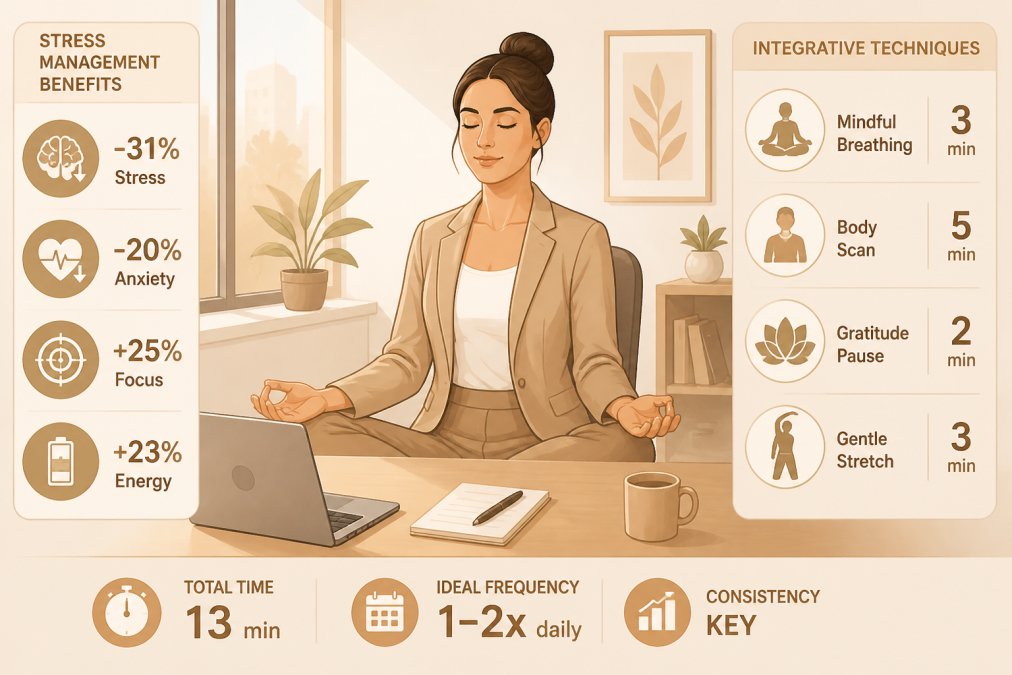
Integrative Health Techniques for Stress Management
Stress lives in your nervous system, muscular tension patterns, breathing rhythm, sleep architecture, and inflammatory state. Addressing only the mental component leaves physical stress patterns intact.
Integrative health techniques combine nervous system regulation, physical release, and behavioral change. You’re rewiring the systems that generate the stress response, not just thinking your way out of stress.
Mindfulness and Breathwork: Quick Practices for Your Day
Mindfulness is observing what’s happening in your body and mind without judgment. Breathwork shifts your nervous system from sympathetic (fight-or-flight) to parasympathetic (rest-and-recover) activation.
A simple 4-count breathing practice, 4 counts in, hold 4, out 4, hold 4, shifts your autonomic nervous system within 90 seconds. Your heart rate decreases. Your muscles relax. Your thinking clarifies. The vagus nerve, which controls parasympathetic activation, responds directly to slow, deliberate breathing.
Practical applications:
- Before high-stakes meetings: 2 minutes of 4-count breathing
- When tension builds: pause and do 5 rounds of 4-count breathing
- During stressful calls: breathe while listening instead of holding tension
- Between tasks: 1 minute of box breathing
Mindfulness extends this by creating a moment of choice. Instead of reacting automatically to stress triggers, you notice the trigger, observe your reaction, and respond intentionally. Over weeks, this rewires your default stress response.
Movement and Physical Activity Without Extra Time
Physical activity is often framed as exercise requiring gym time and scheduling. But movement is a stress management tool that happens within your existing environment.
For busy professionals, this means:
- Desk-based mobility: shoulder circles, neck stretches, spinal twists (2-3 minutes every hour)
- Walking meetings: take calls while moving instead of sitting
- Stairwells: use stairs instead of elevators
- Standing: alternate between sitting and standing throughout your day
- Functional strength: bodyweight movements like squats or push-ups (5-10 minutes, 2-3 times weekly)
The cumulative effect of movement throughout your day exceeds a single workout session. Your metabolism stays active. Your nervous system gets regular resets. Your posture improves. Your stress resilience builds.
A common mistake is waiting until you have time for “real exercise” before starting. That time rarely comes. Start with movement available in your day.
Time Management for Wellness: Prioritizing Your Health
Time management for wellness isn’t about finding more hours. It’s about treating health decisions with the same priority you give work deadlines and client commitments.
Most professionals approach wellness reactively. You go to the gym when you have time. You eat well when you’re not traveling. You prioritize sleep when you’re not overwhelmed. This reactive approach means wellness is always the first thing to drop when pressure increases, exactly when you need it most.
Nutrition and Sleep: Non-Negotiable Foundations
Sleep deprivation impairs decision-making, increases stress reactivity, suppresses immune function, and accelerates aging. Chronic sleep debt compounds these effects. Prioritize 7-9 hours of sleep as a non-negotiable business decision. Schedule sleep like you schedule meetings.
Nutrition operates similarly. Your body runs on the fuel you provide. Skipped meals, constant caffeine, processed foods, and dehydration create baseline inflammation and energy dysregulation.
Intentional nutrition means:
- Eating protein with every meal for sustained energy and recovery
- Hydrating consistently throughout the day
- Minimizing processed foods and added sugars
- Eating on a schedule instead of when stress permits
- Preparing meals in advance
These aren’t diet recommendations. They’re foundational practices supporting every other aspect of integrated wellness.
Start your wellness journey today! →
Digital Wellness and Screen Fatigue Recovery
Digital wellness is critical for busy professionals. You spend 8+ hours daily in front of screens, creating eye strain, postural tension, circadian rhythm disruption, and cognitive fatigue.
Recovery practices:
- 20-20-20 rule: every 20 minutes, look at something 20 feet away for 20 seconds
- Screen-free time before bed (at least 30 minutes) to protect sleep quality
- Posture resets while working: standing, stretching, adjusting screen height
- Deliberate breaks: 5-10 minutes away from screens every 2 hours
- Blue light filters if working late
Digital wellness isn’t about using less technology; it’s about using it in ways that don’t accumulate physiological debt.
Creating Sustainable Integrated Wellness Habits
Sustainability is where most wellness initiatives fail. Sustainable habits are small enough to maintain under stress, anchored to existing routines, and deliver noticeable results quickly enough to reinforce continued practice.
Biometric Tracking: Data-Driven Wellness Decisions
Biometric tracking gives objective feedback on how wellness practices affect your body. Instead of relying on subjective feelings, you have data.
Common biometrics for busy professionals:
- Sleep quality and duration
- Resting heart rate (indicates recovery and stress load)
- Heart rate variability (shows nervous system balance)
- Steps and daily movement
- Hydration status
The value is identifying patterns. You notice that poor sleep reduces stress resilience and increases pain. You see hydration directly affects energy and focus. You observe consistent movement correlates with better sleep and lower resting heart rate.
This evidence-based feedback sustains practice far better than willpower alone. You don’t need expensive devices, a smartphone tracks steps and sleep.
Overcoming Workplace Culture Barriers
The biggest barrier to integrated wellness isn’t knowledge or motivation. It’s workplace culture that penalizes wellness practices. Taking a lunch break, leaving at 5 PM, or taking a walk during work hours can signal you’re not committed.
Individual strategies:
- Frame wellness as performance optimization, not self-care
- Schedule wellness appointments like client meetings
- Practice wellness visibly so others normalize it
- Find colleagues prioritizing health and create mutual accountability
- Document how wellness improves your work quality
The professionals who sustain integrated wellness treat it as non-negotiable, regardless of workplace pressure. They take the walk, protect sleep, and eat intentionally because the cost of not doing it exceeds the social friction.
The most successful shift happens when you stop asking permission to prioritize wellness and start treating it as a business decision about your own performance and longevity.
Why Root Cause Analysis Beats Symptom Management
Conventional medicine excels at managing symptoms. You have pain, you get pain medication. You have anxiety, you get anxiolytics. For chronic issues, this is a dead end, you manage symptoms indefinitely without addressing what’s causing them.
Root cause analysis asks different questions. Why does your back hurt? Is it structural misalignment? Muscular tension from postural strain? Inflammation from poor nutrition? Stress patterns held in your body? Usually it’s multiple factors.
Once you identify actual drivers, you address them. Spinal alignment improves through chiropractic care. Muscular tension releases through massage and stretching. Inflammation resolves through nutritional changes. Stress patterns shift through mindfulness. Mobility rebuilds through consistent movement.
Symptom management provides immediate relief but no long-term improvement. Root cause analysis takes longer initially but produces lasting results. After 8-12 weeks of consistent integrated wellness practice, many professionals report pain reduction, improved energy, better sleep, and reduced stress that persists even if they ease up on practices slightly.
That’s the difference between managing a problem and solving it.
Getting Started: Your First Steps Toward Integrated Wellness
The barrier to starting isn’t understanding the concept. It’s taking the first action.
Week 1: Establish the foundation
- Choose one micro-habit anchor point (e.g., breathing practice with morning coffee)
- Implement 2-minute breathing practice daily
- Track your sleep for one week
- Drink one additional glass of water daily
Week 2: Add movement
- Maintain your breathing practice
- Add one 5-minute walk into your day
- Implement the 20-20-20 screen break rule
- Continue sleep tracking
Week 3: Integrate stress management
- Maintain previous practices
- Add one intentional mindfulness moment
- Implement one nutrition change (e.g., protein with breakfast)
- Assess sleep quality changes
Week 4: Evaluate and expand
- Review what’s working and what feels forced
- Keep sustainable practices
- Drop anything requiring excessive willpower
- Plan your next micro-habit
This progression is deliberately slow. You’re building sustainable practices that compound over months and years, not overhauling your life.
Integrated wellness for busy professionals works because it meets you where you are, managing a demanding schedule, dealing with stress and fatigue, looking for solutions that actually work. The conventional approach of treating symptoms separately doesn’t address underlying drivers.
At Holistic & Wellness Medicine, we’ve built our practice on root cause analysis combined with evidence-based therapies, chiropractic care, functional medicine, massage therapy, natural medicine, and movement practices, that address the whole system. This integrated approach helps professionals restore balance, reduce chronic pain, rebuild energy, and develop the resilience to sustain wellness long-term. If you’re ready to address what’s actually driving your health challenges, schedule a consultation to discuss your specific situation.
Frequently Asked Questions
What does integrated wellness mean for a busy lifestyle?
Integrated wellness treats your body, mind, and spirit as a connected system rather than separate parts. For busy professionals, this means addressing the root causes of fatigue, stress, and pain, not just masking symptoms. Instead of quick fixes, an integrative approach combines evidence-based therapies like functional medicine, stress management, and intentional nutrition to build long-term resilience. You work with practitioners who examine how your work stress, sleep patterns, posture, and diet interact, then develop a realistic plan that fits your schedule.
How can I start an integrated wellness routine with a 60-hour work week?
Begin with micro-habits: 5 minutes of breathwork before meetings, a 10-minute walk after lunch, drinking water consistently, and one intentional meal per day. Stack these habits into activities you already do. The goal is not perfection but consistency. A holistic wellness approach identifies which interventions, whether chiropractic care, functional medicine assessment, or stress management techniques, will have the biggest impact on your specific situation. This targeted approach saves time by addressing root causes instead of pursuing every wellness trend.
How does integrative health differ from traditional wellness programs?
Traditional wellness programs often offer generic advice: exercise more, eat better, reduce stress. Integrative health goes deeper. Practitioners perform functional assessments to find why you're exhausted, tense, or in pain, not just tell you to try harder. They examine your posture, movement patterns, stress response, nutritional status, and sleep quality as interconnected factors. Rather than recommending the same program to everyone, integrative health personalizes your care and combines multiple evidence-based therapies, chiropractic, massage, functional medicine, yoga, to address your specific drivers of poor health.
What are the best time-saving wellness habits for executives?
Prioritize sleep hygiene and hydration first, these amplify everything else. Add 5-minute breathwork sessions or desk stretches between meetings. Use lunch breaks for a walk instead of eating at your desk. Practice digital wellness by taking screen breaks every hour. Consider functional medicine assessments to identify nutritional or hormonal issues draining your energy. One integrated health evaluation can reveal which specific interventions, whether it's targeted chiropractic care, massage therapy, or dietary adjustments, will give you the fastest return on your wellness investment.
This article was written using GrandRanker


5 Natural Remedies for Anxiety and Stress at Home
Discover 5 natural remedies for anxiety and stress at home, from breathing exercises to herbal supplements. Learn how functional medicine can help. Start.

How to Improve Posture to Reduce Pain: A 2026 Guide
Learn how to improve posture to reduce pain with exercises, stretches, and ergonomic tips. Discover a holistic approach to lasting relief. Start today.

How to Treat Adrenal Fatigue Without Medication
Learn how to treat adrenal fatigue without medication using diet, stress management, and natural supplements. Discover practical steps to restore.